

On this page 10 sections
Luxury glam is the most dressed-up of the interior design styles: velvet, marble, crystal, polished metal and rich color, arranged so a room feels like an evening out. Done well it’s elegant and a little theatrical. Done badly it looks like a showroom for shiny things. This guide covers where glam comes from, what goes into it, and, most importantly, how to keep it on the right side of that line.
Old Hollywood: where glam comes from
Modern glam interiors trace back to Hollywood Regency, a style that developed in Los Angeles in the 1930s and 1940s as film stars built and decorated homes to match their screen image. Decorators took the elegant furniture shapes of the British Regency period of the early 1800s, along with French and neoclassical pieces, and turned up the volume with lacquer, mirror, gilt, bold color and dramatic black-and-white contrasts.
Two names come up again and again. William Haines, a silent-film actor who became a decorator, designed interiors for many Hollywood figures. Dorothy Draper, based in New York, was famous for oversized patterns, bold color and big black-and-white floors, and her approach shaped much of what we now call Hollywood Regency.
The style also borrows heavily from Art Deco, the 1920s and 1930s movement of geometric patterns, sunbursts, fan motifs, chrome and lacquer. Hollywood Regency has come back into fashion more than once since, and today’s “glam” borrows from both it and Art Deco.
The key ingredients
Glam rooms usually combine:
- A jewel-toned or high-contrast palette: emerald, sapphire, burgundy or black and white.
- Plush, light-catching fabrics: velvet, silk, satin and faux fur.
- Polished hard surfaces: marble, lacquer, mirror, glass and polished stone.
- Metallics: brass, gold, champagne or polished nickel.
- A statement light, usually a chandelier.
- Symmetry: matched lamps, paired chairs, a centered mirror.
- Curves: round tables, channel-tufted sofas, scalloped edges, arched mirrors.
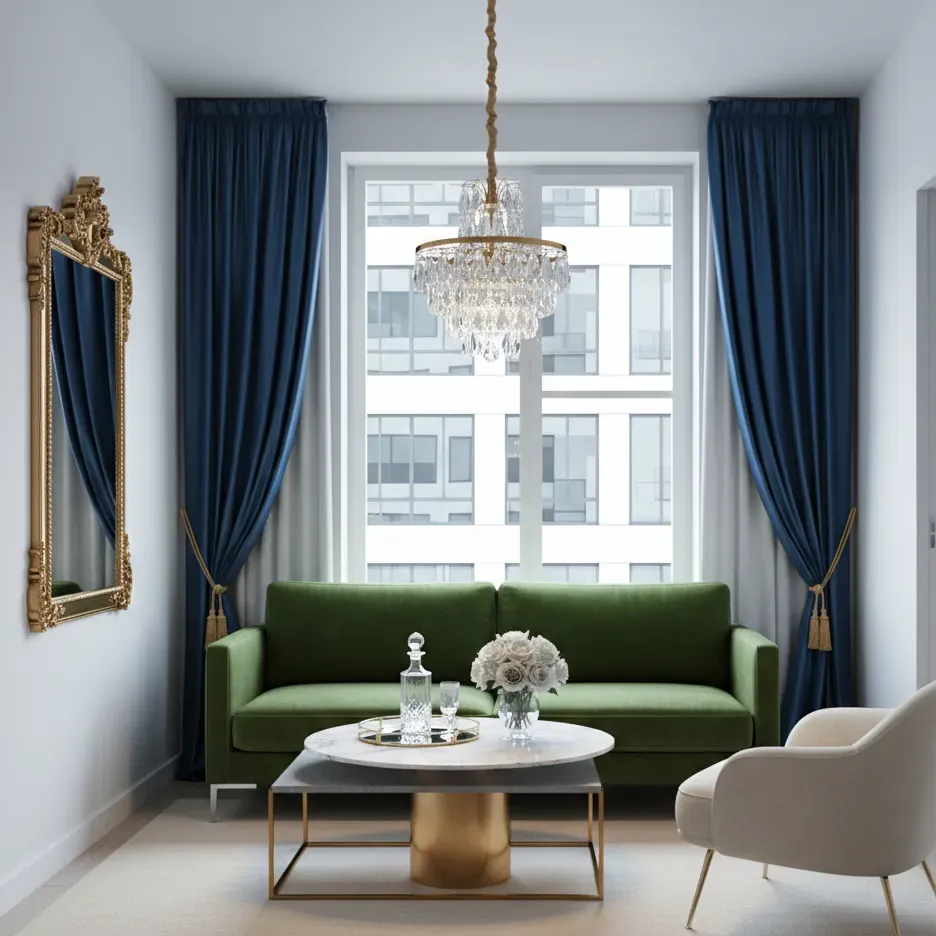
The cover image has nearly all of them: a crystal chandelier, an emerald velvet sofa, heavy navy drapes with tassels, an ornate gold mirror and a round marble-and-gold coffee table with white roses. It’s a deliberately maximal version of the look.
Glam color palette
- Ivory
#F4EFE6 - Emerald
#0F5C4A - Midnight navy
#1F2A44 - Burgundy
#6E1F33 - Antique gold
#C9A24A - Black lacquer
#111111
Pick one jewel tone to lead, pair it with one metal and one neutral, then add black for contrast. Emerald, gold and ivory is classic. Navy, brass and white is crisper. Burgundy, gold and black is moodier. Using emerald, sapphire and burgundy together at full strength is where rooms start to look like a costume.
For a softer take, sometimes called “soft glam”, use cream, champagne, blush and silver, with texture doing the heavy lifting instead of color.
Materials and textures
Glam depends on contrast between soft and hard, and between matte and shine.
- Velvet: sofas, armchairs, headboards, cushions and curtains. It’s the single most “glam” fabric.
- Marble: coffee tables, side tables, lamp bases, trays. Real or a convincing look-alike.
- Mirror and glass: a large framed mirror, mirrored side tables, glass-topped tables, crystal.
- Lacquer and high gloss: a lacquered cabinet or a gloss-painted door instantly reads as Hollywood Regency.
- Metal: brass, gold and nickel on legs, frames, hardware and light fittings.
- Silk, satin and faux fur: in small doses, like a throw or a cushion.
Balance the shine with matte surfaces such as a wool rug, linen-textured walls or painted wood, or the room becomes exhausting to look at.
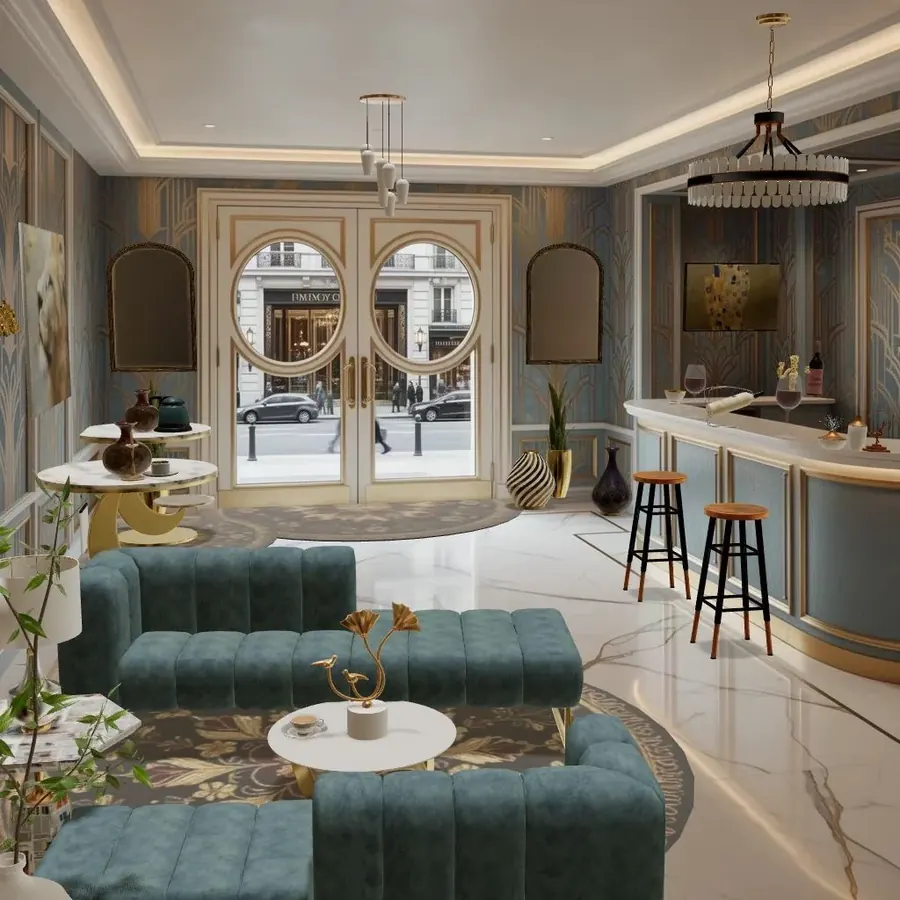
This player’s hotel lounge is a good model for glam that doesn’t shout. There’s one main color (teal velvet), one metal (gold), lots of marble and a fan-patterned wallpaper with an Art Deco feel. The curved bar and channel-tufted sofas give it that rounded, cinematic shape.
Furniture and signature pieces
- A velvet sofa, ideally channel-tufted or curved.
- A round coffee table in marble, glass or lacquer with metal legs or base.
- A pair of matching accent chairs, perhaps with slipper, barrel or Louis-style shapes.
- An oversized mirror with a gilded, sunburst or arched frame.
- A mirrored or lacquered console or sideboard.
- An upholstered headboard that goes taller than usual, in a bedroom.
- A bar cart or drinks cabinet, a Hollywood classic.
- Fresh flowers, especially white roses, peonies or orchids, in a simple vase.
Lighting
Lighting is where glam earns its name.
- A statement chandelier in crystal, glass or brass is the classic centerpiece. Hang it over a coffee or dining table so it relates to something.
- Matched table lamps with metallic, glass or marble bases and pleated or drum shades, placed symmetrically.
- Wall sconces either side of a mirror or a bed.
- Dimmer switches. Glam looks best at evening light levels with warm, low, pooled light. Under bright overhead light, velvet and metal can look flat and cheap.
How to avoid tacky glam
This is the part people search for, and the answer is mostly restraint.
- Edit metallics. Choose one main metal finish. A little silver with gold can work in a bigger room, but most rooms look better with one.
- Don’t make everything shiny. Shine needs a matte background to stand out. A rule of thumb many designers use is to keep high-gloss and metallic surfaces as accents, not the majority.
- Buy fewer, bigger pieces. One large mirror beats six small ones. One serious chandelier beats a cluster of cheap ones.
- Skip the slogans and logos. Fashion-brand books, sequin cushions with words and “glam” signs make a room look like a theme.
- Add something old or natural. A vintage chair, a stack of real books, an antique rug, a big plant. It makes the luxury believable.
- Mind the scale of crystal. A chandelier that’s too small for the room looks like an afterthought; one that’s far too big looks like a set.
- Keep it comfortable. If nobody wants to sit on the sofa, it’s a showroom.
Glam on a budget, in a small space or a rental
- Hang curtains high and wide. Floor-length velvet or heavy faux-silk curtains, mounted close to the ceiling, make any room look grander. In a rental, a tension or freestanding rod can help.
- Lean a big mirror. No drilling, more light, more drama.
- Swap hardware and lamps. New brass knobs and two matching lamps are cheap and transform a room. Keep the old knobs to put back when you move out.
- One velvet piece. A velvet armchair or headboard gives you the look without a velvet sofa budget.
- Use dark color carefully in small rooms. A deep jewel tone on all four walls of a small room can feel cocooning and luxurious, but only with plenty of lamp light.
Glam vs modern and eclectic
Glam’s nearest neighbor is modern: both like bold statements and clean silhouettes, but modern prefers chrome, black leather and graphic art, while glam prefers velvet, gold and crystal. Glam also overlaps with eclectic when people mix antiques and jewel tones, but eclectic is looser and more personal, while glam is polished and symmetrical.
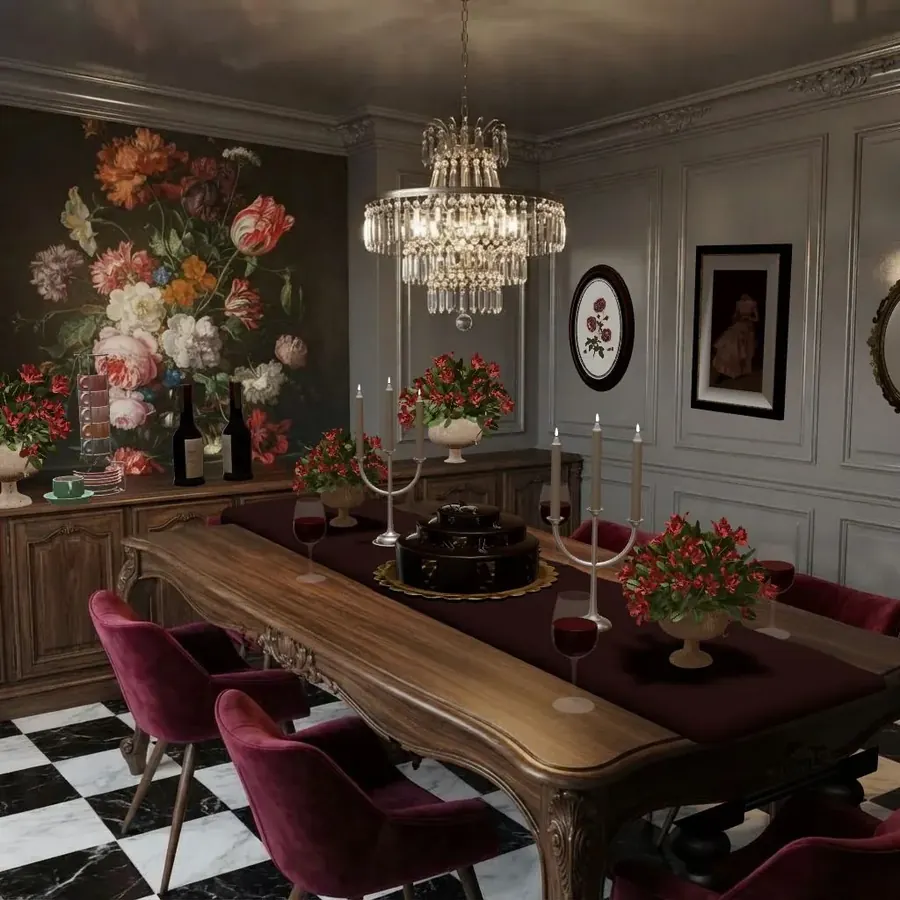
This dining room shows the darker, more dramatic end of glam: a crystal chandelier, burgundy velvet chairs, candlesticks, paneled grey walls and a black-and-white checkered floor that would have made Dorothy Draper smile. The carved wooden table and the dark floral mural keep it from feeling too new.
Try it in Cozee
Glam is easy to overdo, which makes it a perfect style to rehearse before you buy velvet. In Cozee, a free design game for iPhone and Android, you start with an empty 3D room and style it with real 3D furniture and decor. From level 5 you unlock pro editor tools, including material options, so you can test how a piece reads in different finishes. Submit your design, let other players rate it, and see in the community feed how others dressed up the same Space. New to the game? The guide to winning Gold and the overview of interior design styles are good places to start.
Questions people ask
What is Hollywood Regency style?
Hollywood Regency is a glamorous decorating style that developed in Los Angeles during the golden age of cinema in the 1930s and 1940s. It mixes classical and Regency-inspired furniture shapes with bold color, lacquer, mirror, metallics and high-contrast pattern, and it’s the main ancestor of today’s glam interiors.
How do I make my home look luxurious on a budget?
Focus on a few things that read as quality: generous curtains hung high and wide, one large mirror, one velvet piece, warm layered lighting and real flowers. Then remove clutter. Fewer, larger, better-placed things look far more expensive than lots of small shiny ones.
What is the difference between glam and Art Deco?
Art Deco is a specific design movement of the 1920s and 1930s with geometric patterns, sunbursts, stepped shapes, lacquer and chrome. Glam is a broader, modern decorating style that borrows from Art Deco and Hollywood Regency, but also mixes in contemporary furniture and comfort.
What colors are used in glam interiors?
Glam often pairs a deep jewel tone, such as emerald, sapphire, plum or burgundy, with gold or brass, plus a neutral like ivory, black or grey. Softer glam rooms use blush, champagne, cream and silver instead.
Try it in an empty room first
Cozee is a free interior design game for iPhone and Android. Pick an empty 3D room, fill it with real furniture, and see what the community thinks.
4.7 on the App Store · Free, with optional in‑app purchases