

On this page 11 sections
Modern interior design is a style rooted in the modernist movement of the early and mid-20th century: clean lines, no fussy ornament, honest materials like steel, glass and leather, and furniture where the shape itself is the decoration. It’s often confused with contemporary and mid-century modern, which are related but not the same thing. This guide clears that up first, then shows how to build the look.
Modern, contemporary, mid-century: what’s the difference?
These three words get used interchangeably online, but designers mean different things by them.
| Term | What it means | Time frame | Typical look |
|---|---|---|---|
| Modern | A design movement that rejected heavy ornament in favor of function and new materials | Grew from the early 20th century, peaked mid-century | Clean lines, chrome, glass, leather, black and white with bold accents |
| Mid-century modern | A warmer branch of modern design | Roughly mid-1940s to late 1960s | Walnut and teak, tapered legs, molded plywood, organic curves, mustard and teal |
| Contemporary | Whatever is current now | Always changing | Today: soft curves, warm neutrals, bouclé, mixed finishes |
The simplest way to remember it: modern is a fixed style, contemporary is a moving target. A chrome-and-leather room designed in 1965 is still modern. A room that looked contemporary in 2010 (grey everything, chevron prints) now looks of its time.
Where modern design comes from
Modernism grew out of the early 20th century, when designers began rejecting the heavy ornament of the Victorian era. The Bauhaus school, founded in Germany in 1919 by Walter Gropius, became its most famous center: it brought art, craft and industry together and treated furniture as something to be designed for mass production. Bauhaus-trained Marcel Breuer experimented with bent tubular steel for chairs in the mid-1920s, and Ludwig Mies van der Rohe designed the Barcelona chair in 1929. Le Corbusier’s work spread the same ideas through architecture.
The guiding principles were simple: form follows function, ornament is unnecessary, and materials should be honest about what they are. After the Second World War those ideas softened into mid-century modern, with designers such as Charles and Ray Eames, Eero Saarinen and Isamu Noguchi using plywood, fiberglass and organic shapes.
The look today
A modern room is easy to recognize once you know what to look for:
- Clean, straight or gently curved lines. No carving, tufting, fringes or frills.
- Furniture raised off the floor on slim legs, sled bases or metal frames, so the floor shows underneath.
- A restrained base palette with one or two strong accents.
- Smooth, manufactured materials next to a few natural ones.
- Statement pieces as decoration. A sculptural lamp or an iconic chair takes the place of knick-knacks.
- Bold, graphic art and rugs. Stripes, blocks of color, pop art, abstract prints.
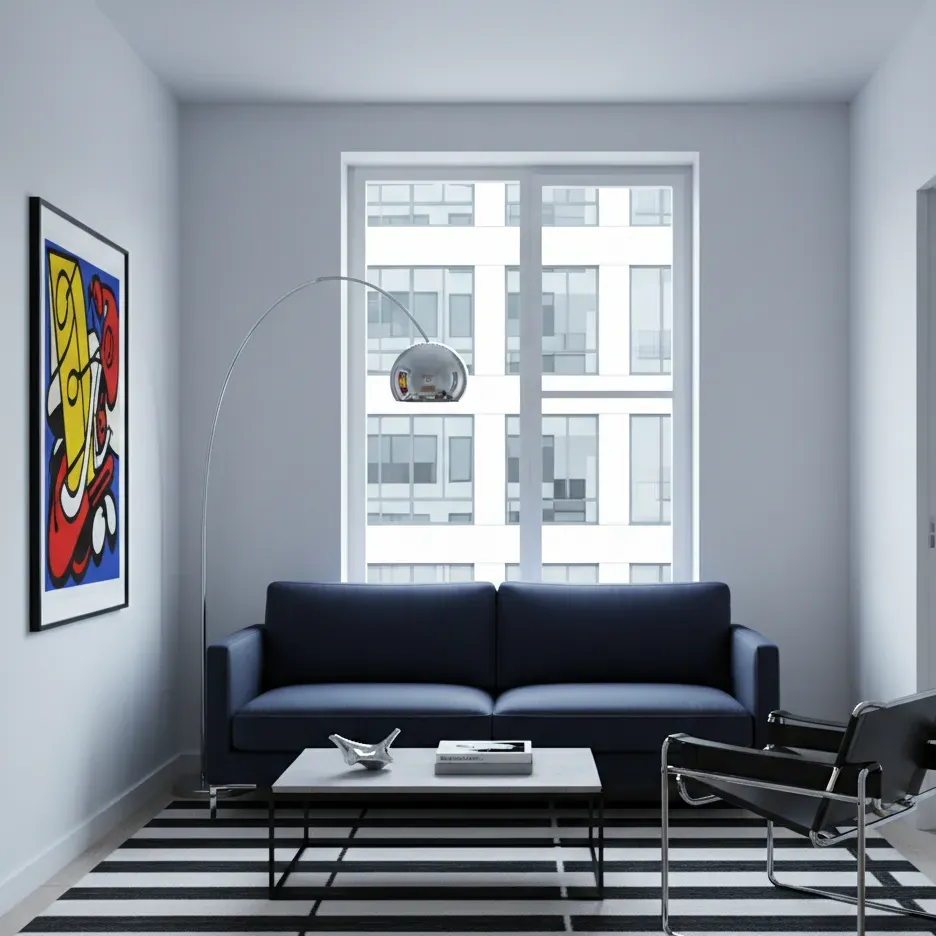
The cover image is the same living room in Cozee styled modern: a navy sofa, a black-and-white striped rug, a chrome arc lamp, a bold pop-art painting, a black leather sling chair and a glass-and-metal coffee table.
Color palette
Classic modern rooms work from black, white and grey, then add punch with a saturated color. Navy, red, cobalt and mustard are all at home here.
- White
#FFFFFF - Concrete
#D9D9D6 - Steel
#8C8C8C - Navy
#1B2A4A - Signal red
#C8102E - Black
#111111
Keep the accent to one or two places (the sofa and a painting, say) so it reads as deliberate. If you’d rather go warmer, borrow from mid-century: walnut, mustard, olive and burnt orange.
Materials
- Chrome and polished steel for lamp arcs, chair frames and table bases.
- Glass tables and shelves that keep a room visually light.
- Leather, usually smooth and black, tan or white.
- Lacquer and laminate in solid colors.
- Wood, in clean slabs or molded plywood rather than carved or distressed.
- Marble or stone, used plainly, for a table top or a side table.
Texture is kept low-key. The interest comes from contrast between materials (glass on chrome, black leather on a white floor) rather than from rough surfaces.
Furniture and signature pieces
A modern room is a good place for one or two pieces with real presence:
- A low, long sofa with square arms or a simple curved back, on legs or a plinth.
- A sling or cantilever chair in leather on a steel frame.
- A glass or marble coffee table with a metal base.
- A molded plywood or fiberglass chair if you’re leaning mid-century.
- A sleek, low media unit or sideboard with flat fronts and no visible handles.
You don’t need designer originals. Plenty of good-quality furniture follows these shapes, and one well-chosen piece will lift a room of simpler ones.
Lighting as sculpture
In modern rooms, lamps are often the art.
- An arc floor lamp that swings a shade over the sofa or coffee table. The Arco lamp by Achille and Pier Giacomo Castiglioni, from 1962, is the famous example.
- Globe pendants in opal glass.
- Sputnik-style chandeliers with radiating arms, a mid-century favorite.
- Simple cylinder or dome table lamps in metal or glass.
Combine one sculptural lamp with discreet recessed or track lighting, and keep bulbs warm enough that the room doesn’t feel like a showroom.
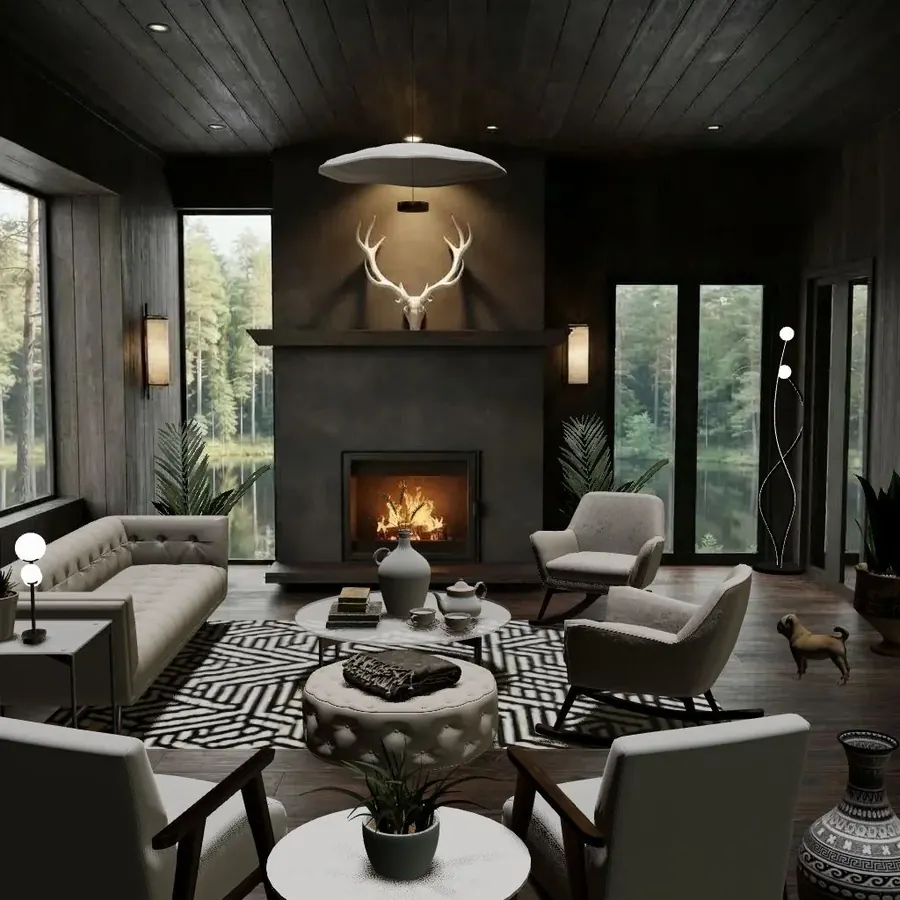
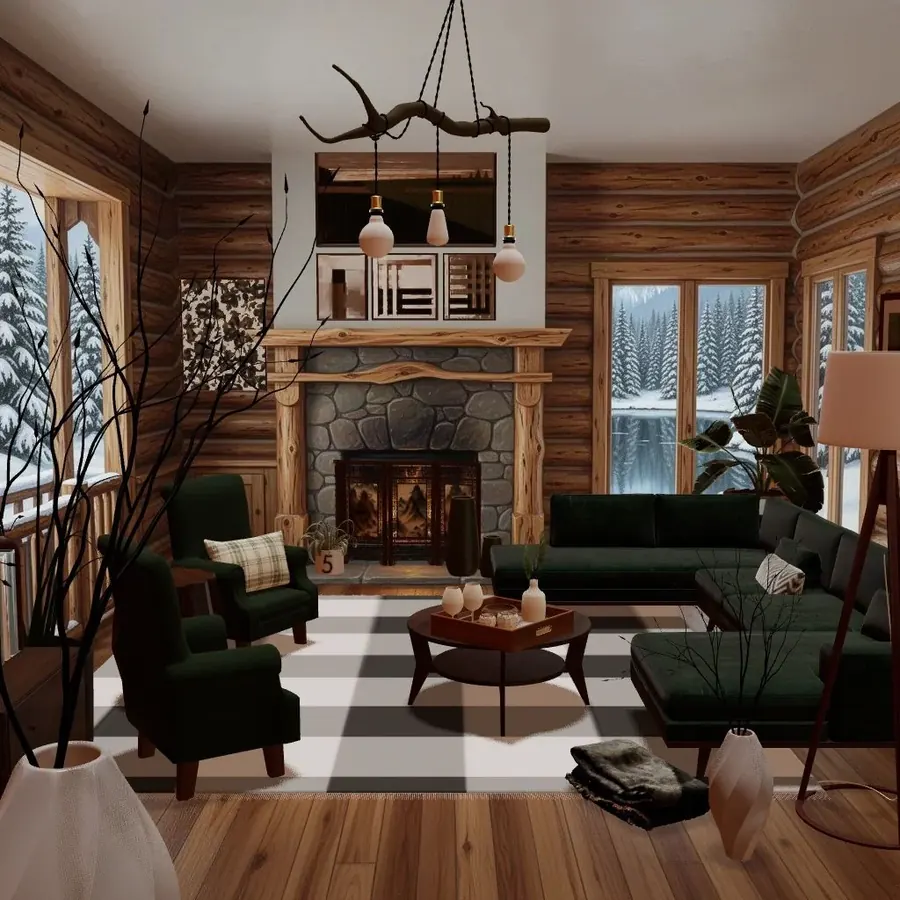
The cabin above shows a moodier, warmer take on modern. The fireplace wall is a single dark plane with no ornament, the black-and-white geometric rug gives the graphic punch, globe lamps add a mid-century note, and the forest view does the rest. The antler mount and the tufted ottoman nudge it toward a cabin mood, a reminder that modern rules are easy to bend.
Modern style in a small space or on a budget
Modern actually suits small rooms, because it values clear floors and fewer pieces.
- Choose leggy furniture. Seeing the floor under the sofa and tables makes a small room feel bigger.
- Use glass and acrylic for the coffee table or side tables; they almost disappear.
- Invest in one icon-style piece (a lamp or chair) and keep the rest simple and affordable.
- Get graphic with a rug. A bold striped or geometric rug is the cheapest way to make a rented room look modern.
- Paint or replace handles. Flat, minimal pulls on old furniture change its whole character.
- Frame big prints simply. Thin black or aluminum frames, oversized artwork, few of them.
Common mistakes
- Mixing up modern and contemporary. If you’re shopping, check what the seller means. “Modern sofa” in many shops just means “new”.
- Making it cold. All chrome, glass and white with no rug, plants or warm light feels like an office lobby. Add a wool rug, some wood and one living thing.
- Too many statement pieces. One iconic chair is striking. Four compete.
- Ornamental extras. Carved frames, tasseled cushions and floral prints work against the clean lines.
- Ignoring scale. Slim, leggy furniture can look lost in a large room. Anchor it with a big rug and one substantial piece.
Modern’s neighbors
Modern sits between several styles, which is why it’s often confused with them:
- Minimalist keeps modern’s clean lines but strips out the bold art and color.
- Industrial shares the metal and leather, but uses rough, aged materials instead of polished ones.
- Luxury glam shares the drama but adds velvet, gold and crystal.
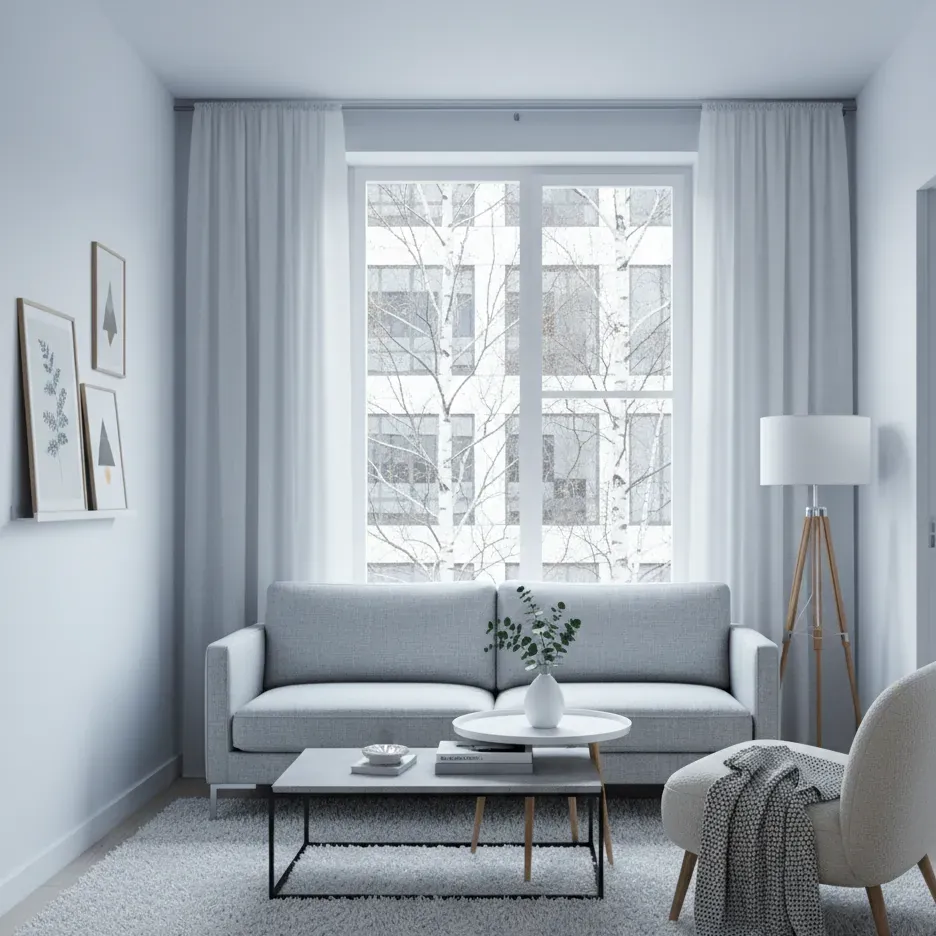
- Scandinavian grew partly from the same mid-century period, but is softer, paler and cozier.
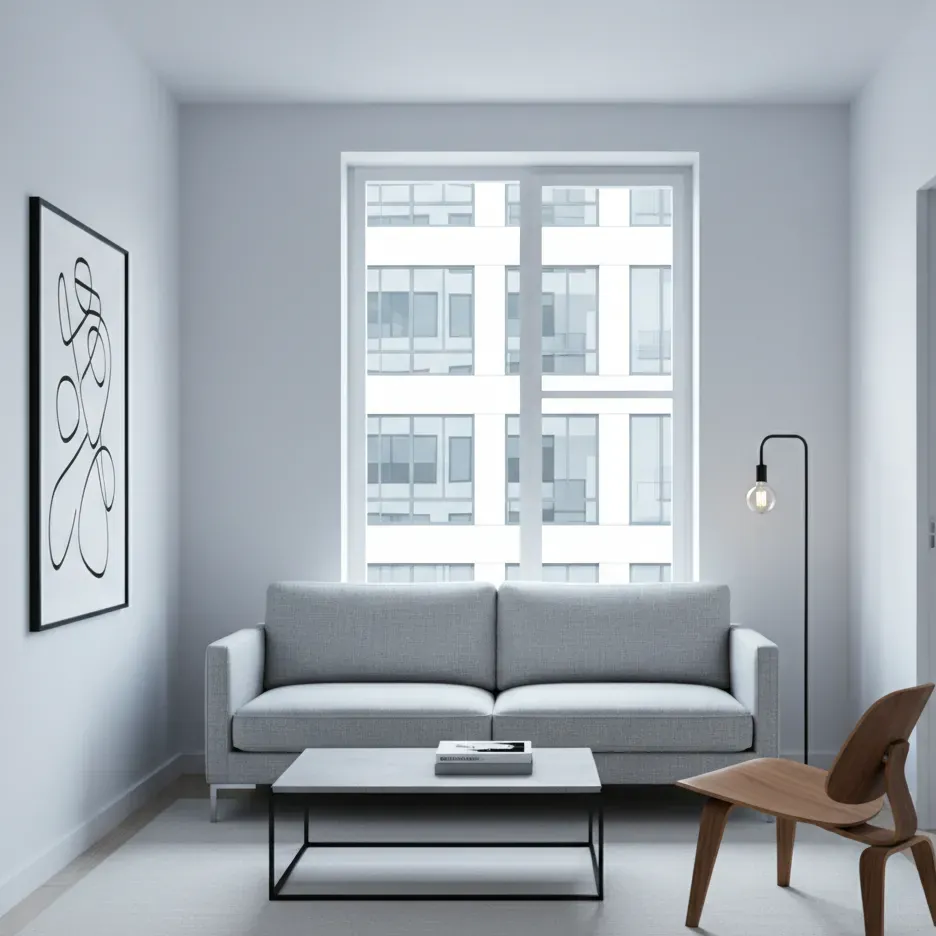
Notice the molded plywood lounge chair here: a mid-century modern shape that sits just as comfortably in a minimalist room.
Try it in Cozee
Modern rooms depend on proportion and contrast, and both are easier to judge on screen than in a furniture shop. In Cozee, a free interior design game for iPhone and Android, each Space starts as an empty 3D room. You design with real 3D furniture and decor (sofas, rugs, lamps, plants, art), dragging pieces in and rotating them to find the right balance. Try building a strict black-and-white version first, then add one bold accent and see how much it changes. If you’d like a sofa in a specific shape, the Sofa Workshop lets you build your own and use it in your designs.
Other players rate the designs you submit, and you can browse how they styled the same Space. For more on getting started, see how to play Cozee, or compare every look in interior design styles explained.
Questions people ask
What is the difference between modern and contemporary interior design?
Modern describes a specific movement that grew in the early 20th century and peaked mid-century: clean lines, honest materials, function first. Contemporary means the design of right now, so it keeps changing. Today’s contemporary rooms often borrow modern ideas, which is why the words get swapped, but a modern room from 1960 is still modern, while a contemporary room from 2010 already looks dated.
Is mid-century modern the same as modern?
Mid-century modern is a branch of modern design from roughly the mid-1940s to the late 1960s. It’s warmer and more organic than early modernism, with walnut and teak, tapered legs, curved molded plywood and fiberglass, and playful color. All mid-century modern is modern, but not all modern is mid-century.
What are the key elements of modern interior design?
Clean lines, little or no ornament, a restrained palette of black, white and neutrals with bold accents, and smooth industrial materials such as chrome, steel, glass and leather. Furniture is often raised on slim legs or frames, and a few sculptural pieces act as the decoration.
Is modern design the same as minimalist?
They’re related but not identical. Minimalism takes modern ideas to an extreme, removing almost everything. Modern rooms can be quite full and colorful, with bold art and graphic rugs, as long as the shapes stay clean and the ornament stays low.
Try it in an empty room first
Cozee is a free interior design game for iPhone and Android. Pick an empty 3D room, fill it with real furniture, and see what the community thinks.
4.7 on the App Store · Free, with optional in‑app purchases