

On this page 10 sections
Minimalist interior design is about keeping only what you use or love, and giving each of those things room to breathe. Expect a calm, mostly neutral palette, simple shapes, very little on display and a lot of deliberate empty space. Done well it feels restful, not bare. Below you’ll find where the look comes from, the difference between warm and stark minimalism, and how to get it right in a real home.
Where minimalism comes from
The minimalist interior grew out of early 20th-century modernism. Architects of the Bauhaus school and the International Style stripped away ornament and focused on function, honest materials and open plans. Ludwig Mies van der Rohe is closely associated with the phrase “less is more”, which became the movement’s shorthand.
Traditional Japanese interiors were another big influence: tatami rooms with almost no furniture, sliding paper screens and a single scroll or flower arrangement in an alcove. In the 1960s the Minimal Art movement in the US pushed the same idea in sculpture and painting, and from the 1990s onward architects and designers made the pared-back white interior a recognizable home style. More recently, the interest in decluttering and owning less has brought minimalism to a much wider audience.
Warm minimalism vs stark minimalism
This is the most useful distinction to understand before you start, because “minimalist” can mean two quite different rooms.
| Stark minimalism | Warm minimalism | |
|---|---|---|
| Walls | Bright white, cool grey | Cream, warm white, soft greige |
| Wood | Little or none, or very pale | Oak, walnut, ash, visible grain |
| Textiles | Smooth, flat, few | Linen, wool, bouclé, chunky knits |
| Metal | Chrome, black steel | Black steel, brushed brass, used lightly |
| Feeling | Gallery, crisp, architectural | Calm, soft, lived-in |
| Risk | Can feel cold or clinical | Can drift into “beige clutter” |
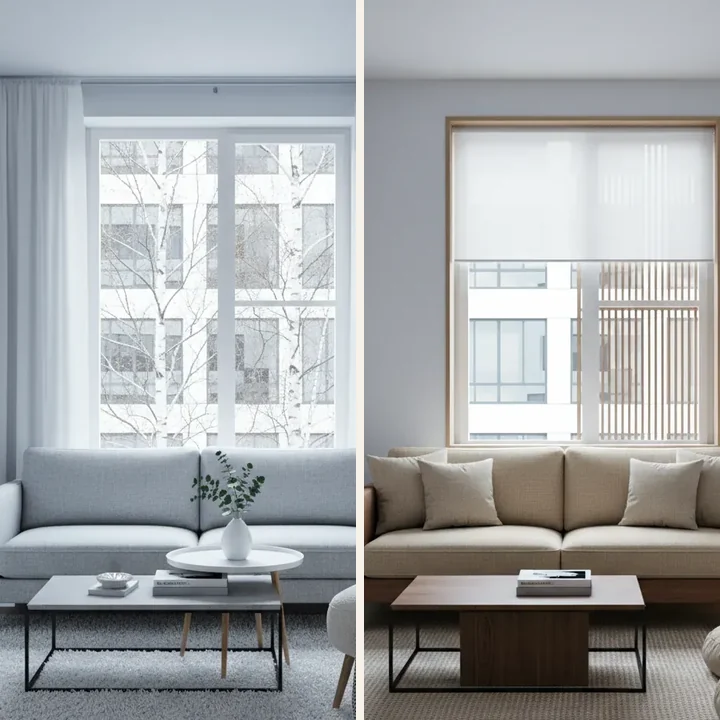
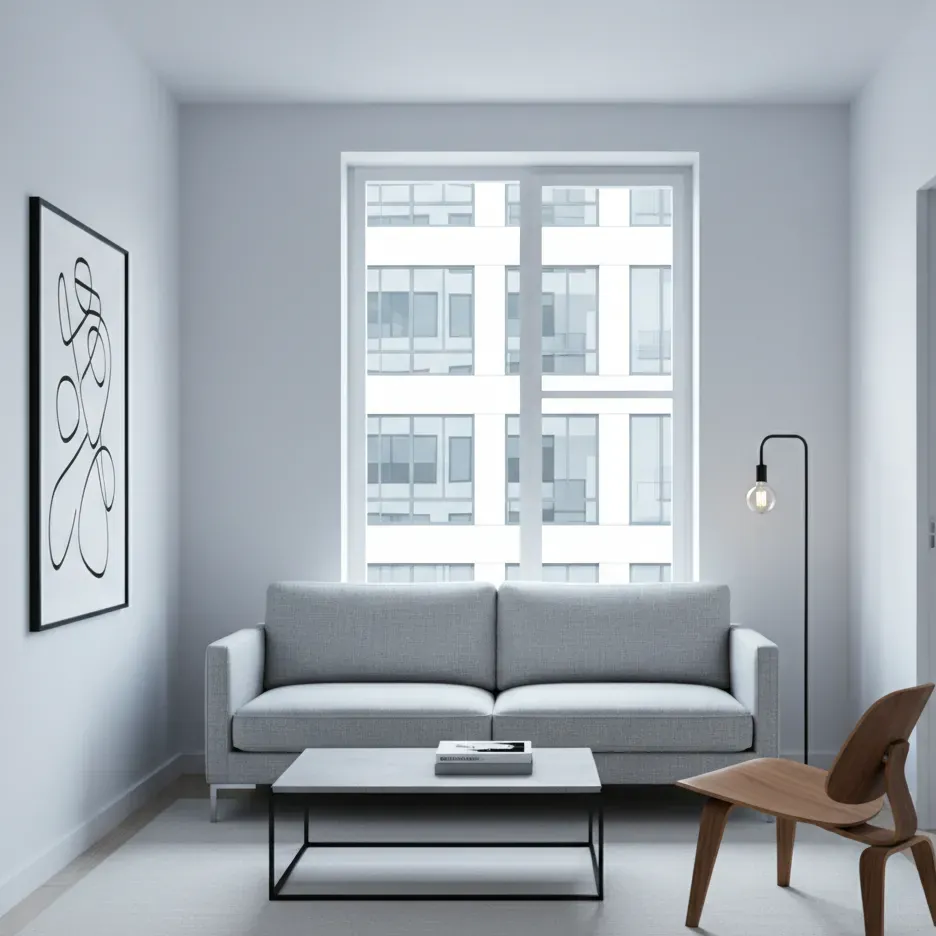
The cover image above sits closer to the stark end: grey sofa, cool walls, a thin black frame table and a single black line drawing. The molded plywood lounge chair is the one warm note, and it does a lot of work.
Most people are happier living in warm minimalism. It keeps the discipline of “fewer, better things” but lets texture and natural materials make the room comfortable.
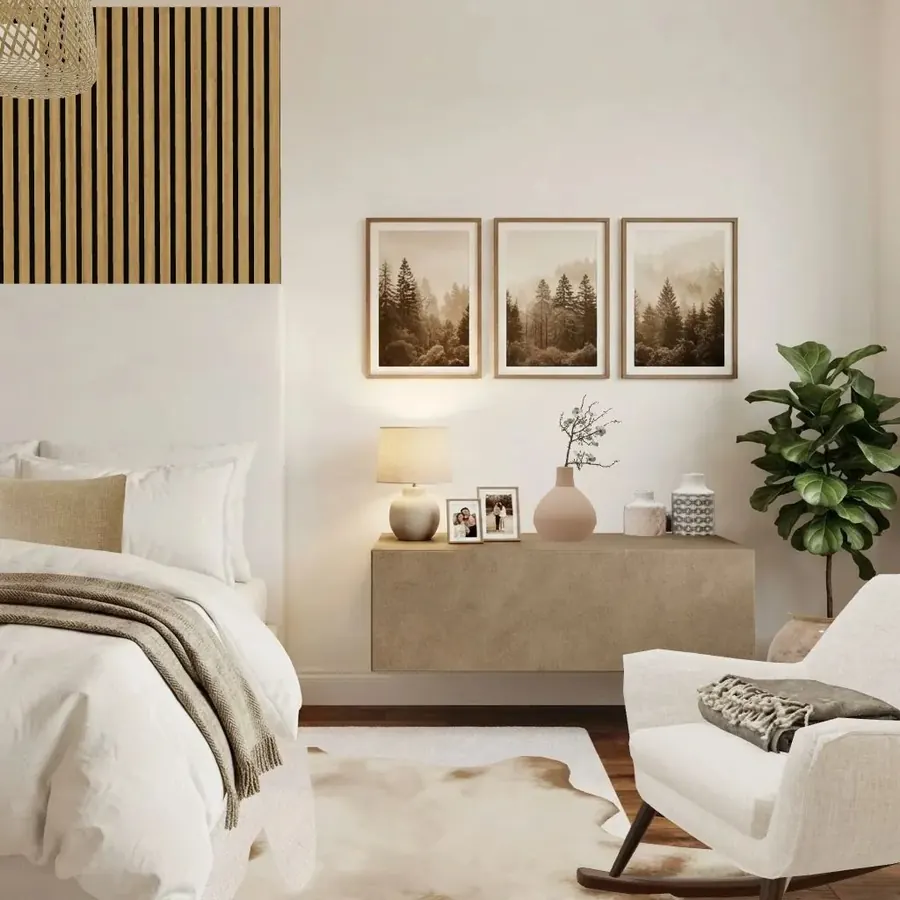
This bedroom is a good example of the warm version. There’s a lot of white, but the slatted wood panel, the cowhide-style rug, the throw on the armchair and the single fiddle-leaf fig keep it from feeling sterile. Notice that the decor is grouped: three prints in a row, a few objects on one floating console, and bare wall everywhere else.
The minimalist color palette
Minimalist palettes are narrow on purpose. Pick one main neutral for walls and big surfaces, one or two supporting tones, and one dark color for lines and accents.
- Warm white
#F6F4F0 - Greige
#E4DFD7 - Oak
#C9B79C - Stone grey
#8A8F8C - Charcoal
#2B2B2B
A few tips:
- Keep the undertones consistent. A cool grey sofa against a yellowy cream wall looks accidental. Decide early whether you’re warm or cool.
- Use black as a drawing tool. Thin black frames, a lamp stem or table legs outline the room like a sketch.
- Allow one quiet accent if you want one, such as a muted green from a single plant or a rust-colored cushion. One, not five.
Materials and textures
When you remove objects, the surfaces left behind become the decoration. That makes material choice more important in minimalism than in almost any other style.
- Wood: solid or veneered oak, ash or walnut with a matte finish. Grain gives visual interest without clutter.
- Stone and concrete: a marble or travertine side table, a concrete lamp base, a plaster-finish wall.
- Textiles: linen curtains, a wool flatweave or low-pile rug, a bouclé chair, a knitted throw.
- Metal: powder-coated black steel or brushed metal, in thin profiles.
- Glass: clear glass keeps sightlines open, which helps small rooms.
Aim for two or three materials repeated around the room rather than eight that appear once each.
Furniture and signature pieces
Minimalist furniture has simple silhouettes, visible legs and nothing fussy: no tufting, carving or skirts.
- A low, clean-lined sofa with slim or square arms in a solid fabric.
- A simple coffee table: a thin frame, a solid wood slab or a round stone top.
- One sculptural chair. Mid-century molded plywood, a cantilevered chair or a curved wood lounge chair gives the room a focal point without adding clutter.
- Closed storage. This is the secret of every minimalist home. Flat-front cabinets, built-in cupboards and a media unit with doors hide everything that would otherwise sit on surfaces.
- One large artwork instead of a gallery wall, or nothing at all.
Lighting
Lighting in a minimalist room should be quiet in form and warm in effect.
- Choose fixtures with simple shapes: a globe pendant, a slim arc or stick floor lamp, a paper or linen-shaded table lamp.
- Layer it. A ceiling light alone flattens a pared-back room; add at least one floor lamp and one table lamp.
- Use warm white bulbs (around 2700K) for living rooms and bedrooms. Cool daylight bulbs are the fastest way to make minimalism feel clinical.
- Hidden light, like an LED strip under a floating shelf or behind a headboard, adds glow without adding objects.
Minimalism in a small space or a rental
Minimalism suits small spaces naturally, because fewer pieces means more floor and more light. A few practical moves:
- Edit first, buy second. Take everything off your surfaces and only put back what earns its place. It costs nothing and is the biggest change you’ll make.
- Pick multi-use furniture, such as a storage bench, a bed with drawers or a nesting side table.
- Choose leggy pieces. Seeing floor under the sofa and table makes a room feel bigger.
- Hide rental features you can’t change. A plain linen curtain across open shelving, a large rug over a dated floor, and one big framed print hung on picture hooks or strips over a busy wall.
- Repaint only if allowed. If you can’t, lean into whatever neutral the walls already are and match your textiles to it.
On a budget, spend on the pieces you touch every day (sofa, bed, a good rug) and save on the rest. Second-hand mid-century chairs and solid wood tables are often better value than new flat-pack pieces.
Common mistakes
- Emptying the room without adding texture. Bare is not the same as minimal. If it echoes, add a rug and curtains.
- Too many small objects. Ten little vases read as clutter; one large vase reads as a decision.
- No storage plan. If there’s nowhere to hide things, surfaces fill up within a week.
- Mixing warm and cool neutrals at random.
- Making it a showroom. A room you’re afraid to sit in isn’t working. Keep a throw, a book, a plant. Minimalism should make life easier.
Minimalist vs Scandinavian and Japandi
Minimalism’s nearest neighbors share its calm, but they add things it doesn’t insist on.
- Scandinavian is minimalism with more coziness and personality: pale wood, sheepskins, botanical prints, more plants and more textiles. See the Scandinavian guide.
- Japandi blends Japanese and Scandinavian design: lower furniture, darker woods alongside light ones, handmade ceramics and a strong focus on craft and imperfection. See the Japandi guide.
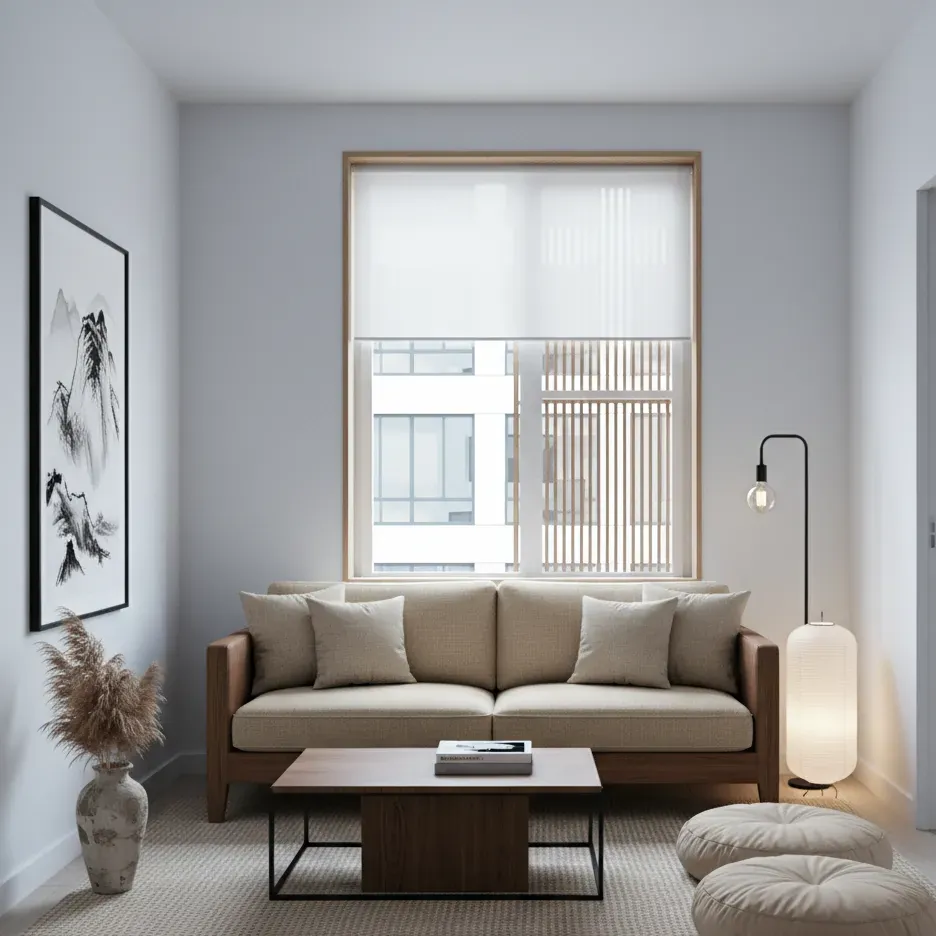
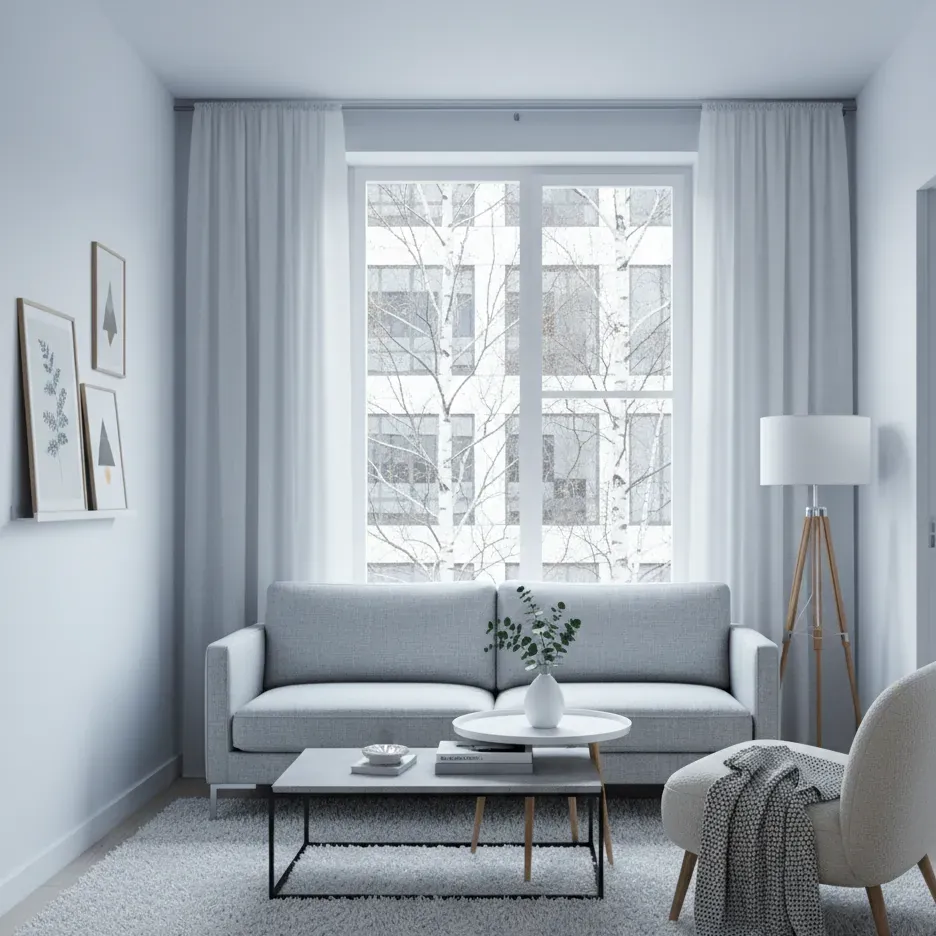
Compare this to the cover image: same room, same window, but the Japandi version adds floor cushions, a paper lantern, pampas grass and darker wood. Minimalism is the stricter of the two. If you’re unsure which you prefer, the design style quiz is a quick way to find out.
Try it in Cozee
Minimalism is harder than it looks, because every piece is on show. That makes it a good look to practise before you buy anything. In Cozee, a free interior design game for iPhone and Android, every Space starts as an empty 3D room. You drag in real 3D furniture and decor, move and rotate each piece, and decide what to leave out. There’s even a Designer Task called Empty Room Big Vibes.
Try styling a room with as few pieces as you can, submit it, and let other players rate it. Then browse the community to see how others furnished the same Space with more or less. If you’re new, start with the beginner’s guide, or compare minimalism with the other looks in our overview of interior design styles.
Questions people ask
What is the difference between minimalist and modern interior design?
Modern design is a broad family of clean-lined, 20th-century-rooted looks that can still be bold, colorful and busy. Minimalism is stricter about quantity: fewer objects, quieter colors and lots of empty space. A modern room can have a pop-art painting and a striped rug; a minimalist room usually keeps both out.
How do I make a minimalist room feel cozy instead of cold?
Add warmth through materials rather than objects: a wool or jute rug, linen curtains, a wood table, a bouclé or textured chair. Swap cool white bulbs for warm ones and light the room from lamps at different heights instead of one ceiling light.
Is minimalist decor expensive?
It doesn’t have to be. You buy fewer things, so you can afford to buy each one a bit better. The cheapest minimalist move of all is removing what you already own and don’t love.
What colors are used in minimalist interiors?
Mostly whites, off-whites, soft greys, beige and greige, with black used sparingly as a line or accent. Warm minimalism leans toward cream, sand and oak; stark minimalism toward bright white, cool grey and black.
Try it in an empty room first
Cozee is a free interior design game for iPhone and Android. Pick an empty 3D room, fill it with real furniture, and see what the community thinks.
4.7 on the App Store · Free, with optional in‑app purchases