

On this page 9 sections
Scandinavian and Japandi share a love of wood, calm and good craft, so they are easy to confuse. The short version: Scandinavian is light, soft and bright, with pale birch and oak, white or pale grey walls and cozy layered textiles. Japandi is quieter and more grounded, with pale and dark wood together, lower furniture, fewer textiles and earthy accents like clay, olive and charcoal. If a room makes you want to curl up under a knitted throw, it’s probably Scandinavian. If it makes you want to sit still and breathe out, it’s probably Japandi.
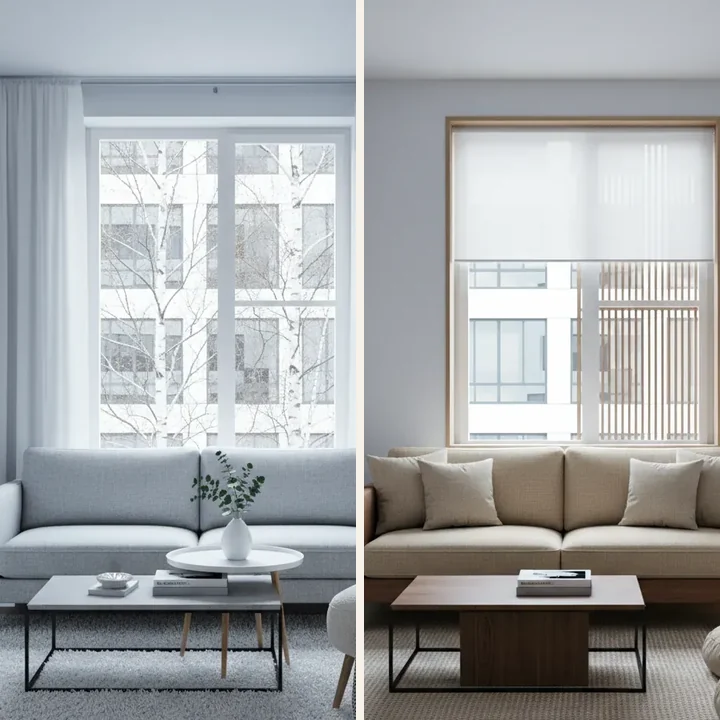
The cover shows the difference cleanly: the same room, split down the middle. On the left, a light grey sofa, white sheer curtains, a round white side table and a shaggy pale rug, with birches outside. On the right, a beige sofa on a wooden frame, a solid dark wood coffee table, a flat woven rug and a pale blind instead of curtains.
The differences at a glance
| Scandinavian | Japandi | |
|---|---|---|
| Overall mood | Bright, soft, homely | Quiet, grounded, still |
| Walls | White, warm white, very pale grey | Warm off-white, sand, greige |
| Wood | Mostly pale: birch, ash, light oak | Pale and dark together: oak with walnut or black-stained wood |
| Furniture height | Standard, on slim tapered legs | Often low, on solid bases or chunky frames |
| Shapes | Rounded, soft, a little playful | Rectilinear and calm, with some soft curves |
| Textiles | Layered: knits, sheepskin, shaggy rugs | Fewer and flatter: linen, cotton, flat-weave rugs |
| Accent colors | Sage, dusty blue, blush, ochre | Clay, olive, charcoal, black |
| Objects | Some cozy accessories, candles, prints | A few handmade pieces, a branch, ink art |
| Windows | Sheer white curtains | Blinds, paper screens or plain linen |
| Roots | Nordic homes in long, dark winters | Japanese restraint meets Nordic comfort |
Palette: bright neutrals vs earthy neutrals
Both palettes are neutral, but they lean in different directions. Scandinavian neutrals are cool to soft: snow white, fog grey and pale birch, with a muted accent so the room doesn’t go flat.
- Snow
#F7F5F0 - Fog
#E6E2DA - Birch
#D9C3A0 - Sage
#A8B5A2 - Fjord
#7D8C99 - Charcoal
#3B3B3B
Japandi neutrals are warmer and earthier: rice paper, sand, oak and walnut, grounded by olive and charcoal.
- Rice paper
#F2EDE4 - Sand
#DCCFBD - Oak
#B89C7D - Walnut
#8A6F55 - Olive
#7C8270 - Charcoal
#2F2C2A
A useful test is to look at the darkest color in the room. In a Scandinavian room, dark tones appear as thin lines: a black frame, a lamp stem, chair legs. In Japandi, dark tones can fill whole surfaces, like a walnut coffee table or a charcoal cushion. If you’re unsure how much of each to use, our guide to color theory for rooms explains the 60-30-10 split.
Wood tones: one family vs a deliberate contrast
This is the most visible difference. Scandinavian rooms use one pale wood family (birch, ash, light oak, beech), with slight variation so it doesn’t look flat-packed. Japandi rooms mix light and dark on purpose: an oak floor with a walnut table, or a pale bench next to a black-stained cabinet. Two or three tones is plenty.
Both keep finishes matte or oiled. High gloss belongs to neither. For more on combining woods without it looking random, see materials and textures.
Shapes and height
Scandinavian furniture sits at a normal height on slim, tapered legs, which shows floor underneath and keeps a small room feeling airy. Curves are common: round coffee tables, egg-shaped lounge chairs, soft sofa arms.
Japandi furniture often sits lower, with solid bases or visible chunky frames: a sofa on a wooden plinth, a coffee table that’s a simple block, floor cushions instead of a second armchair. Lines are calmer and more rectangular, softened by a paper lantern or a round ceramic vase.
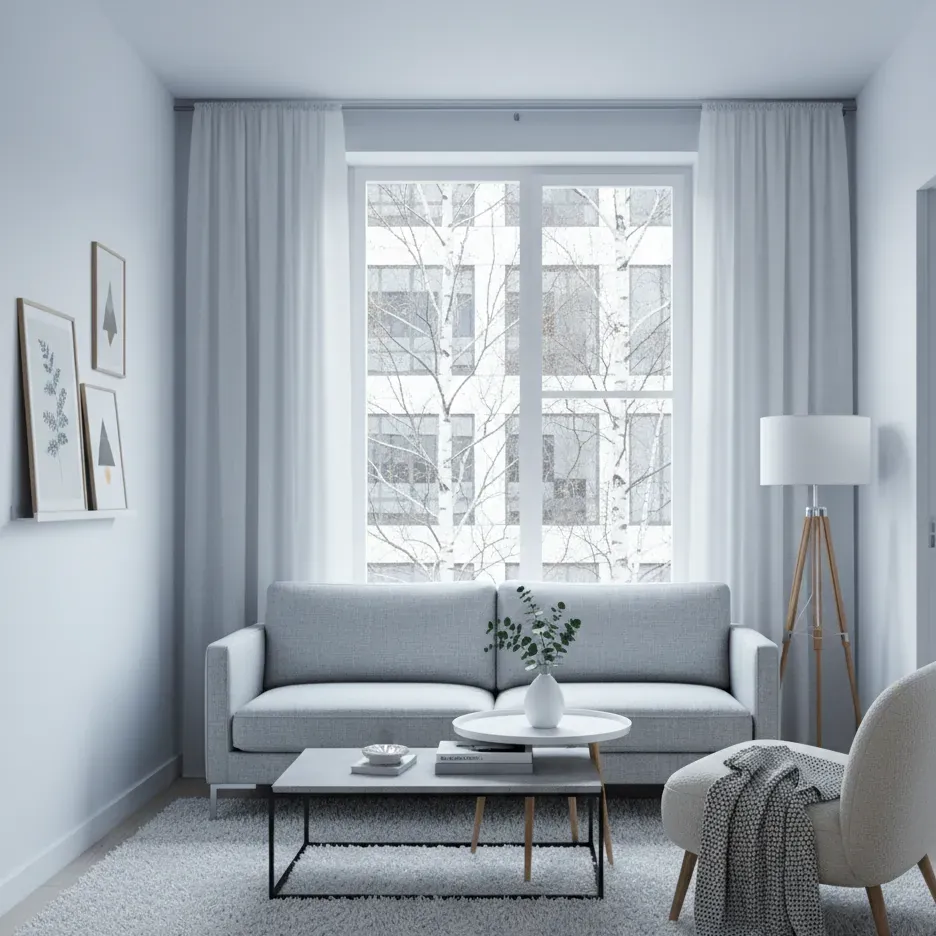
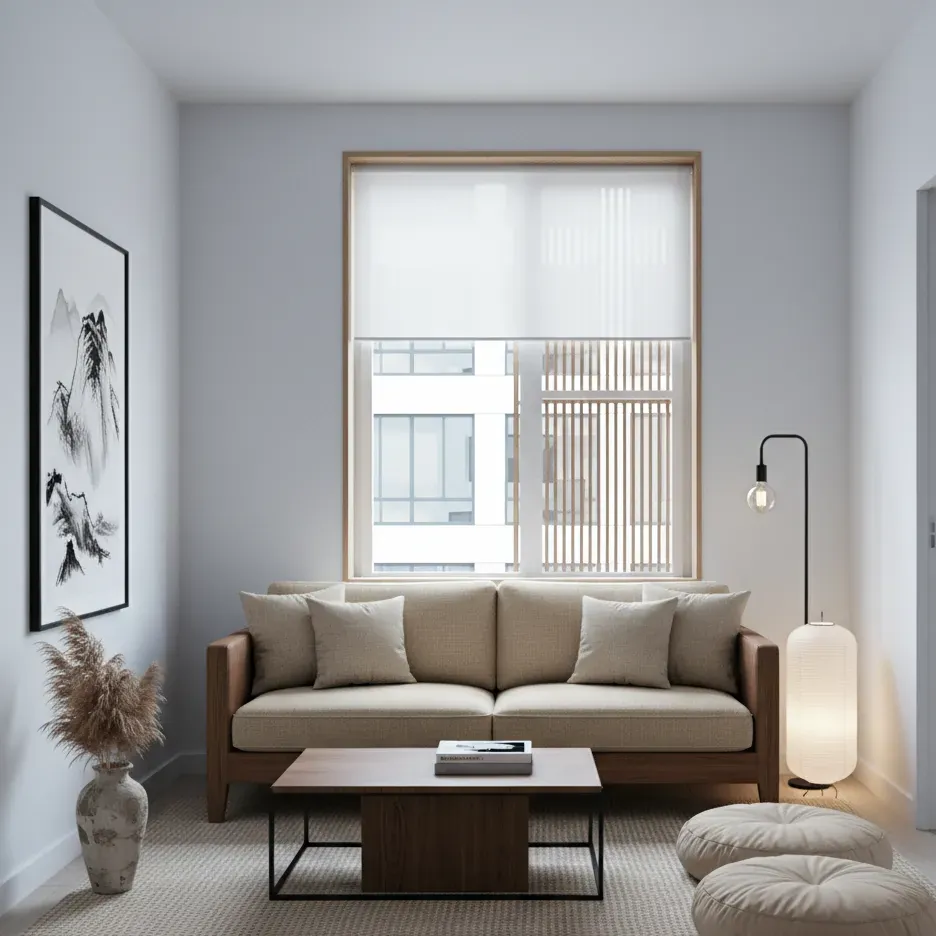
Look at the two rooms above, which are the full versions of the cover. The layout is almost identical. What changes is the weight: the Scandinavian room floats on thin legs and soft textures; the Japandi room sits down into the floor.
Clutter and objects
Neither style likes clutter, but they hold back for different reasons.
- Scandinavian keeps surfaces clear so daylight can bounce around, then adds comfort objects: a throw, candles, a few framed prints, a plant. It’s allowed to feel lived in.
- Japandi treats empty space as part of the design. Display surfaces are mostly bare, with one or two meaningful objects: a handmade bowl, a stem of dried grass, a single ink painting. Storage is closed.
If you find yourself editing a Scandinavian room down to almost nothing, you’re drifting toward minimalism rather than Japandi. Japandi still needs texture and warmth, or it feels like a waiting room.
Where each style comes from
Scandinavian design grew out of Denmark, Sweden, Norway and Finland, where long, dark winters made light and warmth indoors a priority. It became known internationally in the 1950s, through designers such as Alvar Aalto, Hans Wegner and Arne Jacobsen. Pale surfaces bounce daylight; lamps and textiles take over in the dark months.
Japandi is a newer name, widely used from the late 2010s, for an older overlap. Japanese and Nordic design share respect for natural materials, careful craft and simple forms. Japandi adds the Japanese side: low furniture, paper and dark-stained wood, a love of empty space and wabi-sabi, the appreciation of things that are imperfect and aging gracefully. Our guide to wabi-sabi interiors goes deeper into that idea.
How to blend the two
Most real rooms that look “Scandi” or “Japandi” are a mix. The trick is to let one style lead, roughly 80/20, and borrow a few pieces from the other.
A Scandinavian room with a Japandi touch:
- Swap one pale piece for walnut or smoked oak, such as a side table or a picture frame.
- Replace one ceiling shade with a paper lantern.
- Take away one throw and one cushion. Keep the rest.
- Add a single ceramic vase with a branch instead of a cluster of small accessories.
A Japandi room with a Scandinavian touch:
- Add one soft, nubbly wool throw or a sheepskin on a chair.
- Bring in a tripod floor lamp or a lamp with a fabric shade at reading height.
- Use one muted Nordic accent, like sage or dusty blue, in cushions.
- Let in more daylight with sheer linen instead of a blind.
Both styles depend on warm light. Choose bulbs around 2700K and use several sources at different heights; our layered lighting guide explains how.
Which one suits you?
Your home and habits matter more than which photo you prefer.
| If you… | Lean toward |
|---|---|
| Live somewhere dark, or have a north-facing room | Scandinavian (paler surfaces bounce light) |
| Love soft textures, candles and a pile of blankets | Scandinavian |
| Have kids or pets and a lot of everyday stuff | Scandinavian, with open shelves and baskets |
| Find busy rooms tiring and want a calm retreat | Japandi |
| Already own dark wood furniture you like | Japandi |
| Are happy to keep things in closed storage | Japandi |
| Want a bedroom that helps you wind down | Either; see our Japandi bedroom ideas |
Still not sure? Take the style quiz, then read the full Scandinavian guide or the Japandi guide for the piece-by-piece details.
Try it in Cozee
The fastest way to feel the difference is to style the same room twice. In Cozee, a free interior design game for iPhone and Android, every Space starts as an empty 3D room that you furnish with real 3D furniture and decor. Do a Scandinavian version with a light sofa, a round table and a tripod lamp, then a second design in the same Space with a low wooden frame, a dark coffee table and a paper lantern. There’s no timer, so you can swap pieces until each version feels right. Other players rate what you submit, and you can browse how others styled the same room.
Questions people ask
What is the main difference between Scandinavian and Japandi?
Scandinavian is brighter and softer: pale wood, white or light grey walls, layered knits and standard-height furniture. Japandi is calmer and more grounded: it mixes pale and dark wood, sits lower to the floor, uses fewer and flatter textiles and leans on earthy accents like clay and charcoal.
Is Japandi just Scandinavian with dark wood?
Not quite. Dark wood is the quickest visible difference, but Japandi also borrows Japanese ideas: low furniture, more empty space, paper lanterns and handmade objects with a little imperfection. Swap the wood without changing those and the room still reads as Scandinavian.
Which is better for a small apartment, Scandinavian or Japandi?
Both work. Scandinavian is better at making a dark, small room feel lighter because it uses paler colors everywhere. Japandi is better at making a small room feel calm, because it relies on fewer, lower pieces and closed storage. Many small homes do best with a mix.
Can you mix Scandinavian and Japandi in one room?
Yes, and most real rooms that look like either style are already a mix. Keep one style as the lead, roughly 80 percent, and borrow two or three things from the other, such as a walnut side table or a paper lantern in a mostly Scandinavian room.
Try it in an empty room first
Cozee is a free interior design game for iPhone and Android. Pick an empty 3D room, fill it with real furniture, and see what the community thinks.
4.7 on the App Store · Free, with optional in‑app purchases