

On this page 12 sections
A Japandi bedroom is built from a few simple moves: a low wooden bed, warm neutral walls, pale and dark wood together, flat linen bedding, soft, low light from paper or fabric shades, closed storage and only a handful of objects on show. Get those right and the room feels calm without feeling bare. The ten ideas below go through each one, with sizes where they help.
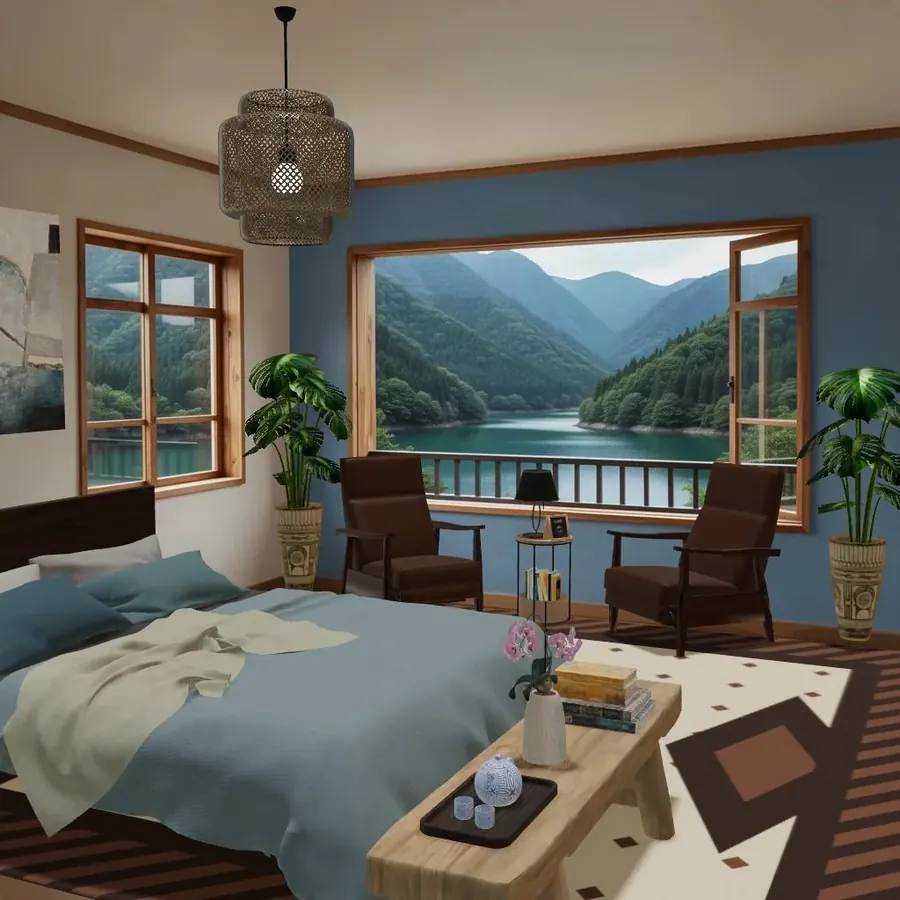
The cover isn’t a textbook Japandi bedroom, and that’s useful. It has strong bones: wood-framed windows, a low light-wood bench at the foot of the bed with a tea tray on it, two simple wooden armchairs turned toward a mountain lake, and a calm, uncluttered layout. What pulls it away from Japandi is the color and pattern: a saturated blue wall, a bold geometric rug and patterned plant pots. Swap those three for warm sand walls, a plain flat-weave rug and stoneware pots, and it’s most of the way there. We’ll come back to it below.
If you’re new to the style, read our Japandi guide first. This one is about the bedroom.
1. Lower the bed
The low profile is the most recognizable part of Japandi. A typical bed puts the top of the mattress around 55–65 cm (22–26 in) from the floor; a low platform bed brings it down to about 35–45 cm (14–18 in). That frees up more wall above the bed, which makes a room feel taller and quieter.
- Choose solid wood with a simple, slightly chunky frame. Oak, ash or walnut, matte or oiled.
- A platform extending a little past the mattress gives you a ledge for a book or a cup.
- A mattress on the floor is the most traditional option, but it traps moisture underneath. If you go this way, use slats or a breathable base, and air it regularly.
Keep the clearance around the bed generous: at least 60 cm (24 in) on each side and at the foot. Our cozy bedroom ideas cover placement in more detail.
2. Use warm neutrals, then ground them
Start from the Japandi palette and let the deep tones appear in the bed frame, a lamp base or a throw.
- Rice paper
#F2EDE4 - Sand
#DCCFBD - Oak
#B89C7D - Walnut
#8A6F55 - Olive
#7C8270 - Charcoal
#2F2C2A
For walls, warm off-white, sand, greige or a soft clay all work. If you love color, a muted, earthy shade is fine; the cover’s bright blue is what makes it read as a different style. For help with undertones, see how to choose paint colors.
3. Mix two or three wood tones on purpose
Japandi is happy to put pale and dark wood together: a walnut bed with an oak bench, or a pale floor with a black-stained nightstand. The cover already does this nicely, with a pale bench in front of a dark headboard and dark chairs. Keep it to two or three tones and repeat each one at least twice. Our guide to materials and textures explains how to mix woods without it looking random.
4. Dress the bed flat and natural
Where a Scandinavian bed is piled with knits and sheepskins, a Japandi bed is simpler.
- Linen or washed cotton in oatmeal, stone, sand or a muted olive. Creases are fine; that’s part of the look.
- Two sleeping pillows plus one or two cushions at most.
- One throw folded at the foot, in wool or waffle cotton.
- Avoid shiny fabrics, like satin or polyester with a sheen.
5. Light it low and soft
Light makes or breaks a Japandi bedroom. Skip the bright central fitting where you can.
- A paper lantern as a pendant or floor lamp is the signature piece.
- Low bedside lamps with linen or ceramic bases. With a low bed, the lamps can sit lower too, on a low nightstand or even the platform itself.
- Warm bulbs, 2700K or lower, ideally on dimmers.
- Keep one color temperature in the room so the light looks consistent.
Our layered lighting guide explains ambient, task and accent light in depth.
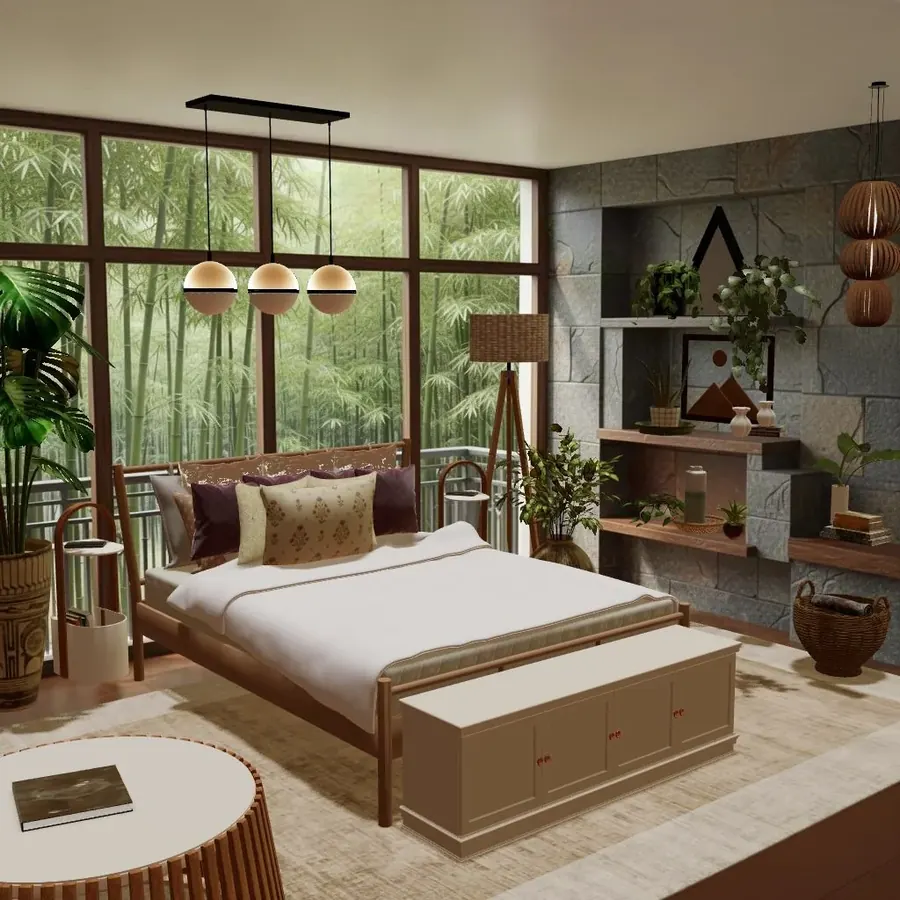
The bamboo bedroom above shows the materials well: a grey stone wall, warm wooden shelves, white linen, a woven-shade floor lamp and a stacked slatted wooden pendant. To push it closer to Japandi, you’d remove most of the plum and patterned cushions, edit the shelves down to two or three objects, and swap the globe pendants for a paper lantern.
6. Hide almost everything
Clutter is the fastest way to lose the mood. Plan closed storage before you buy any decor.
- A simple wooden wardrobe or built-ins with flat, handle-less doors.
- Under-bed drawers or boxes, if your platform allows.
- A bench or chest at the foot of the bed, like the bench in the cover or the storage bench in the bamboo bedroom. Choose one about two-thirds the width of the bed and around 40–45 cm (16–18 in) high.
- Lidded baskets for the things that always pile up: chargers, books, spare blankets.
7. Choose a few objects, and give them space
A Japandi bedroom should have mostly bare surfaces. Pick three to five things for the whole room:
- One handmade ceramic vase, bowl or lamp.
- One branch or dried stem in that vase.
- One piece of art: ink, calligraphy, a soft landscape or a textile.
- One tray for the nightstand, like the tea tray on the bench in the cover.
If you have shelves, style them with far fewer items than usual. Our guide on how to style shelves explains the basics; for Japandi, stop at the step where you think “one more”.
8. Soften the window, don’t dress it up
Big, fussy curtains don’t suit the style. Choose one of these instead:
- Linen curtains in sand or off-white, hung high and wide.
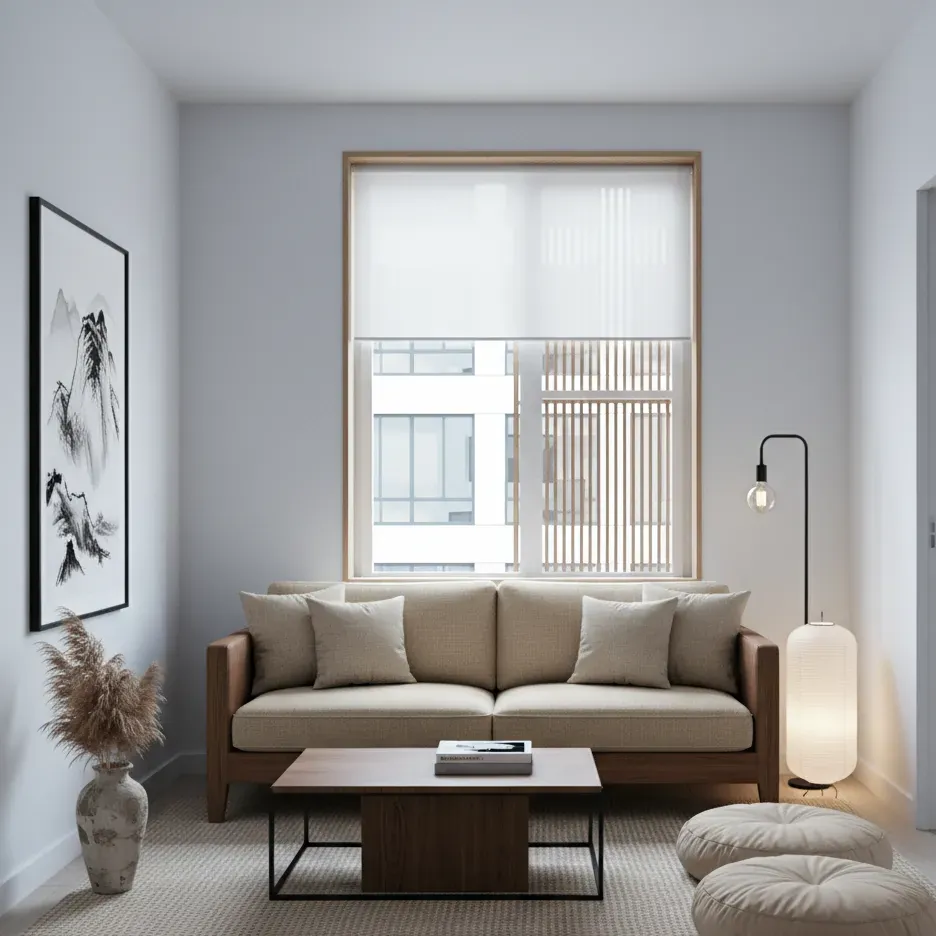
- Paper-look or fabric roller blinds that diffuse the light.
- Wooden slatted blinds or a slatted screen for privacy.
If you’re sleeping in, add a blackout layer behind linen, rather than heavy dark drapes in front.
9. Pick one sculptural plant
Japandi prefers one strong plant to a jungle. Good choices are an olive tree, a fiddle-leaf fig, a snake plant or a small bonsai on a low table. The cover’s two monsteras in patterned pots are lovely, but for Japandi you’d keep one and move it into a plain stoneware or clay pot. Check your light first; houseplants by light will help.
10. Make a quiet corner
The best idea in the cover image is the pair of chairs facing the view. A Japandi bedroom often has one small place that isn’t the bed: a low chair with a lamp, a floor cushion by the window, a bench for tea. Keep it simple and low. If there’s no view, face the chair toward a plant or a single piece of art.
Common mistakes
- Beige everything. Without one or two dark wood or charcoal elements, the room goes flat.
- Too many “zen” props. Stones, fountains and statues tip it into a theme.
- Patterned rugs and bedding. Keep pattern very quiet: a tiny check, a subtle stripe, or none.
- Cold, bright light. It turns warm wood grey.
- Forgetting comfort. A bedroom still needs a soft rug where your feet land.
Try it in Cozee
Japandi is all about restraint, so it’s worth practicing on a bedroom where you can add and remove pieces freely. In Cozee, a free design game for iPhone and Android, you furnish empty 3D rooms with real furniture and decor. Furniture you buy comes with uses, and a use is only spent when you submit a design with that piece, so you can add a bench, a lantern-style lamp, plants and extra cushions, then take half of it out again. Other players rate each design you submit, which is a good test of whether your calm room reads as finished.
Questions people ask
What makes a bedroom Japandi?
A low bed, warm neutral colors, a mix of pale and dark wood, flat natural textiles like linen and cotton, soft diffused light such as a paper lantern, closed storage and only a few handmade objects on show. The room should feel calm and grounded, not bare.
What color should a Japandi bedroom be?
Warm off-white, sand, greige or a soft clay on the walls, with bedding in oatmeal, stone or muted olive. Ground it with one or two deep tones, like a walnut bed frame, a charcoal throw or black lamp bases. Bright white and saturated colors work against the mood.
Do you need a floor bed for a Japandi bedroom?
No. A low platform bed gives the look without the downsides of a mattress on the floor. Aim for a frame where the top of the mattress sits roughly at knee height or a little below, and choose solid wood with a simple, chunky profile.
How do I make a Japandi bedroom feel cozy and not cold?
Layer texture rather than color: linen bedding, a wool or jute rug, a ceramic lamp, wood with visible grain. Use warm bulbs around 2700K or lower, keep light sources low, and add one plant and one soft throw. Calm doesn’t mean empty.
Try it in an empty room first
Cozee is a free interior design game for iPhone and Android. Pick an empty 3D room, fill it with real furniture, and see what the community thinks.
4.7 on the App Store · Free, with optional in‑app purchases