

On this page 10 sections
For most living rooms the answer is bigger than you think: usually 200 × 300 cm (about 6.5 × 10 ft) or 240 × 300 cm (8 × 10 ft), large enough that the front legs of the sofa and every chair sit on it. Under a dining table, the rug should reach 60–75 cm (24–30 in) past the table on every side. Under a bed, it should show 45–60 cm (18–24 in) on each side where you step out. Below is how to work out the right size for your own room, with a table of common sizes and the mistakes that make rugs look wrong.
Why rug size matters so much
A rug does three jobs at once. It defines a zone (this is the sitting area, this is the dining area), it joins furniture into a group, and it brings color, pattern and softness into the biggest surface in the room. When it’s too small, it does none of those things: the sofa and chairs look like they’re drifting apart, the rug looks like a doormat in the middle, and the room feels smaller than it is.
Rugs are also one of the biggest single purchases in a room, so it’s worth measuring before buying rather than guessing. If you’re still at the empty-room stage, our guide on how to furnish an empty room explains why the rug is one of the first decisions to make, right after the focal point.
Common rug sizes at a glance
Sizes vary between countries and brands. These are the common standard sizes; each metric size is paired with the nearest imperial size sold, so the two columns don’t always match exactly:
| Metric (cm) | Imperial (ft) | Typically works for |
|---|---|---|
| 60 × 90 | 2 × 3 | Doormats, bathrooms, beside a single bed |
| 80 × 150 | 2.5 × 5 | Beside a bed, small entryways |
| 70 × 240 | 2.5 × 8 | Runners: hallways, beside a bed, galley kitchens |
| 120 × 170 | 4 × 6 | Small reading corners, under a small round table |
| 160 × 230 | 5 × 8 | Small living rooms, under a double bed’s lower half |
| 200 × 300 | 6.5 × 10 | Medium living rooms, queen beds |
| 240 × 300 | 8 × 10 | Most living rooms, six-seat dining tables, queen and king beds |
| 270 × 360 | 9 × 12 | Large living rooms, king beds, big dining tables |
| 300 × 400 | 10 × 13 | Large open-plan zones |
Living room: the three layouts
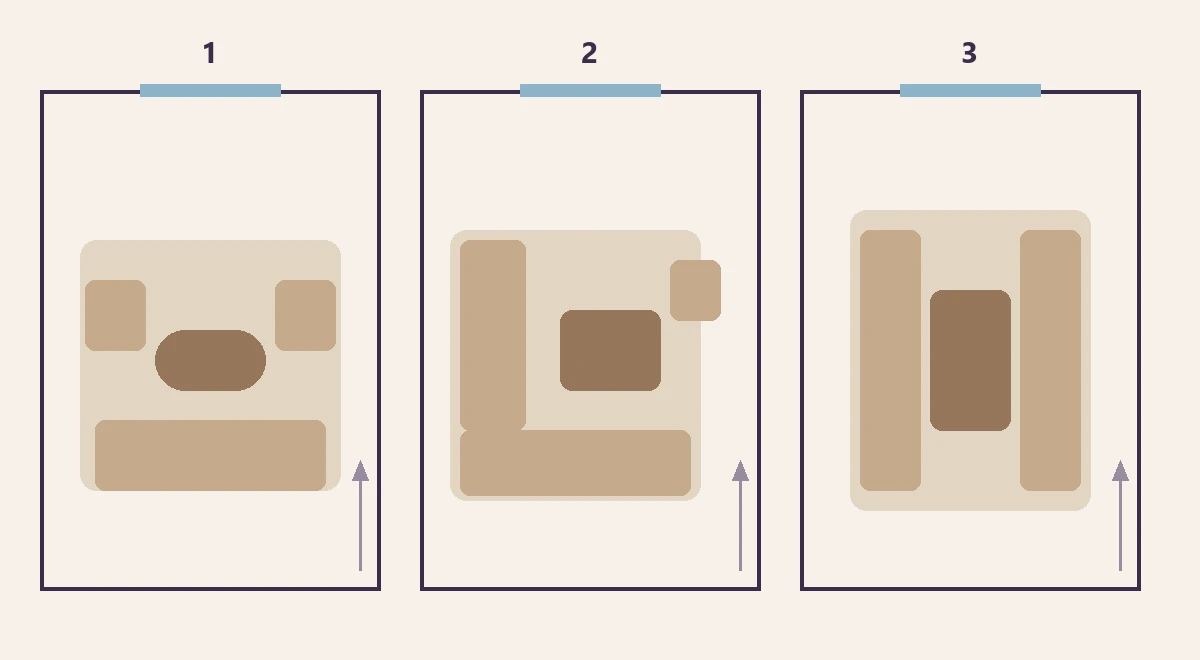
Start by drawing the seating group on the floor: the sofa, the chairs and the coffee table, with the walkways around them. The rug serves that group, not the whole room.
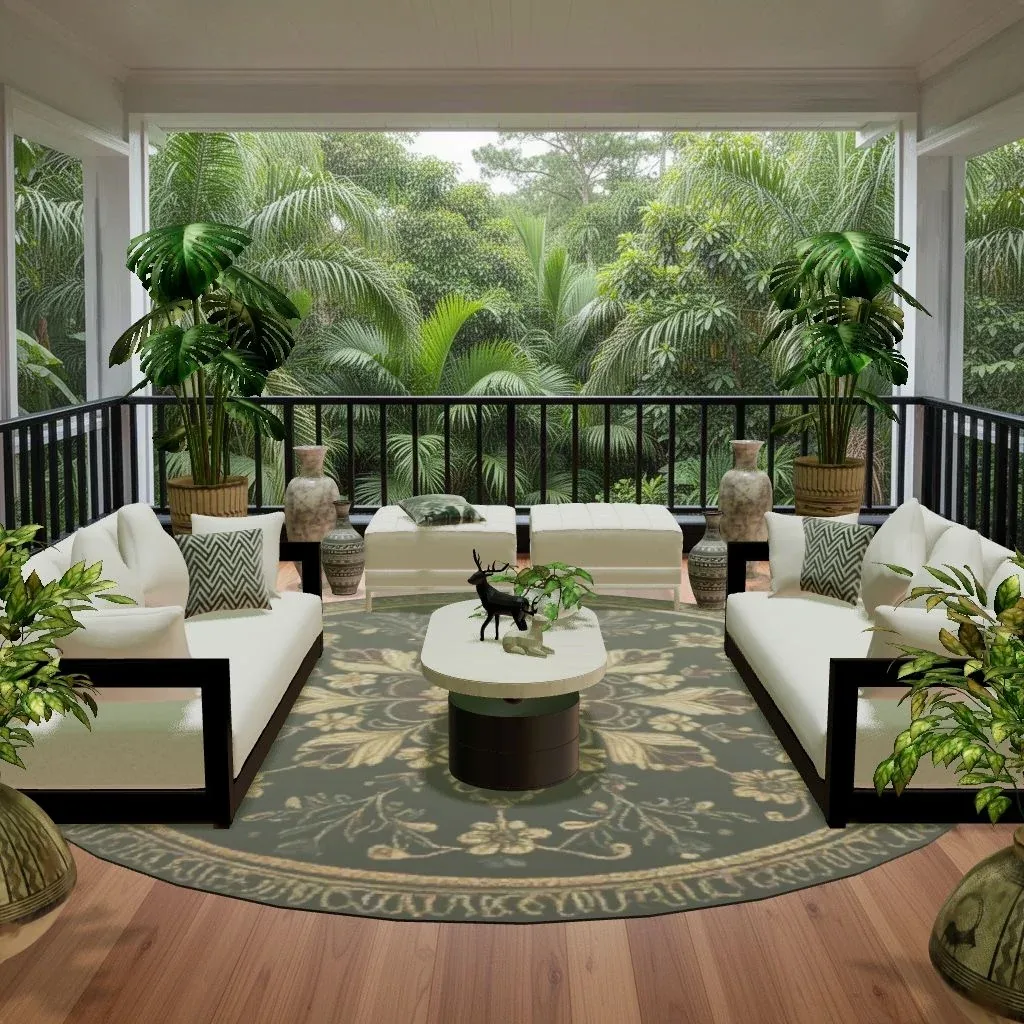
- All legs on. Every piece of seating sits fully on the rug. It looks generous and pulled-together, and it works best in larger rooms. The rug needs to be roughly 15–30 cm (6–12 in) bigger than the seating group on each side.
- Front legs on (the safe default). The front legs of the sofa and chairs sit on the rug and the back legs on the floor. It connects the group without needing a huge rug, and it works in most rooms. Aim for at least 15–20 cm (6–8 in) of rug under the front of the sofa.
- Floating in front. The rug sits in front of the sofa, under the coffee table only. It’s the weakest option and it’s only worth it in a very small room. Even then, the rug should be clearly wider than the coffee table, ideally close to the sofa’s width.
Width rule: in all three layouts, the rug should be at least as wide as the sofa. Better still, it should reach about 15–20 cm (6–8 in) past each end, so the sofa doesn’t look as if it’s overhanging a mat.
Border rule: leave about 30–45 cm (12–18 in) of bare floor between the rug and the walls in a typical room, and about 20 cm (8 in) in a small one.
Dining room: let the chairs stay on
The rule here is practical. When someone pulls out a chair to sit down, its back legs shouldn’t catch on the edge of the rug.
- Measure the table, then add 60–75 cm (24–30 in) on every side.
- A four-seat table of around 90 × 150 cm (3 × 5 ft) usually needs about 200 × 300 cm (6.5 × 10 ft).
- A six-seat table usually needs 240 × 300 cm (8 × 10 ft), and a long eight-seater often needs 270 × 360 cm (9 × 12 ft).
- Match the shape: a round table looks best on a round or square rug, and a long table on a long rectangle.
- Flat-woven or low-pile rugs are easier for chairs to slide on and easier to clean under a table.
Bedroom: the soft first step
What matters in a bedroom is where your feet land in the morning.
| Bed | Common rug choice | Placement |
|---|---|---|
| Single | 120 × 170 cm (4 × 6 ft) or a runner beside it | Beside the bed, or under the lower half |
| Double | 160 × 230 cm (5 × 8 ft) | Turned sideways under the lower two-thirds |
| Queen | 200 × 300 or 240 × 300 cm (6.5 × 10 or 8 × 10 ft) | Under the lower two-thirds, nightstands off the rug |
| King | 270 × 360 cm (9 × 12 ft) | Under the lower two-thirds or the whole bed |
Aim for 45–60 cm (18–24 in) of rug on each side of the bed, and a little more at the foot if there’s room. If a big rug isn’t in the budget, two runners, one on each side of the bed, do the same job for less. More bedroom ideas are in cozy bedroom ideas.
Hallways, kitchens and entryways
- Runners: leave about 10–15 cm (4–6 in) of floor showing on each side and 15–30 cm (6–12 in) at each end. Pick the length to suit the hallway. A runner that stops halfway down looks accidental.
- Entryways: the rug should be wider than the door when it opens, and it shouldn’t catch on it. Check the door clearance before buying anything thick.
- Kitchens: a flat-weave runner in front of the sink and counter, washable if possible.
Shape, pile and layering
- Round rugs soften a room full of straight lines and suit round tables, reading corners and entryways. Size them like a rectangle: they should still contain the chairs’ front legs.
- Pile height: low-pile and flat-weave rugs are hard-wearing and good under tables and doors. Thick shag is cozy underfoot in bedrooms, but harder to clean.
- Layering is the designer’s trick for when the rug you love is too small. Put a large, plain jute or sisal rug down to get the size right, then lay the smaller patterned one on top. It also works well in bohemian and rustic farmhouse rooms.
- Use a rug pad. It stops slipping, protects the floor and makes a thin rug feel more substantial.
How to test a size before you buy
- Mark it out with painter’s tape on the floor, using the exact rug size you’re considering.
- Leave it for a day and walk around it. Does it reach under the sofa legs? Does the border look even?
- Check the doors. Doors should clear the rug, especially if it’s thick.
- Size up if in doubt. A rug that’s slightly too big almost always looks better than one that’s slightly too small.
Common rug mistakes
- Too small. By far the most common mistake. Furniture floats, and the room shrinks.
- Centered on the room instead of on the furniture. The rug belongs to the seating group. In an open-plan room, each zone gets its own rug.
- Touching the walls. Without a border it reads as carpet, and the shape of the room disappears.
- Ignoring the pattern scale. A small, busy pattern on a huge rug can feel restless. Big rooms usually suit bigger patterns or calm textures. For more, see scale and proportion.
- One rug for an open-plan space. Two well-sized rugs, one for sitting and one for dining, define the zones far better than one giant compromise.
Try it in Cozee
Rugs are one of the easiest ways to see how much a size changes a room. In Cozee, a free interior design game for iPhone and Android, every room starts empty. You can drop in a rug, slide the seating around it and see whether it pulls the group together, before you decide on the rest. For layout ideas that start from the rug, read how to furnish an empty room, step by step.
Questions people ask
Should the sofa sit on the rug or off it?
In most living rooms, the front legs of the sofa and chairs should sit on the rug, with the back legs on the floor. It joins the seating into one group. In a large room you can put all the legs on the rug; in a very small room a rug that sits just in front of the sofa can work, but it should still be wider than the coffee table by a good margin.
How much floor should show around a rug?
A border of bare floor around 30–45 cm (12–18 in) wide is the usual target in a living room or bedroom. In a small room it can shrink to about 20 cm (8 in). If the rug touches the walls, it starts to read as wall-to-wall carpet.
What size rug goes under a dining table?
Measure the table and add about 60–75 cm (24–30 in) on every side, so the chairs stay on the rug when someone pulls theirs out to sit down. For a typical six-seat table that usually means a rug around 240 × 300 cm (8 × 10 ft).
Is it better to go bigger or smaller with a rug?
If you’re between two sizes, the bigger one is almost always the better choice. A rug that’s too small makes furniture look like it’s floating and makes the whole room feel smaller.
Try it in an empty room first
Cozee is a free interior design game for iPhone and Android. Pick an empty 3D room, fill it with real furniture, and see what the community thinks.
4.7 on the App Store · Free, with optional in‑app purchases