

On this page 12 sections
A small home office works when the desk is big enough for how you actually work, there’s room to push the chair back, daylight comes from the side rather than behind the screen, the cables are hidden, and you can close the whole thing away at the end of the day. You don’t need a spare room. A corner, an alcove or a window-side table can all become a good place to work if you plan these five things. Here’s how, with the measurements that matter.
Decide how much you’ll work there
Be honest about this first, because it changes everything.
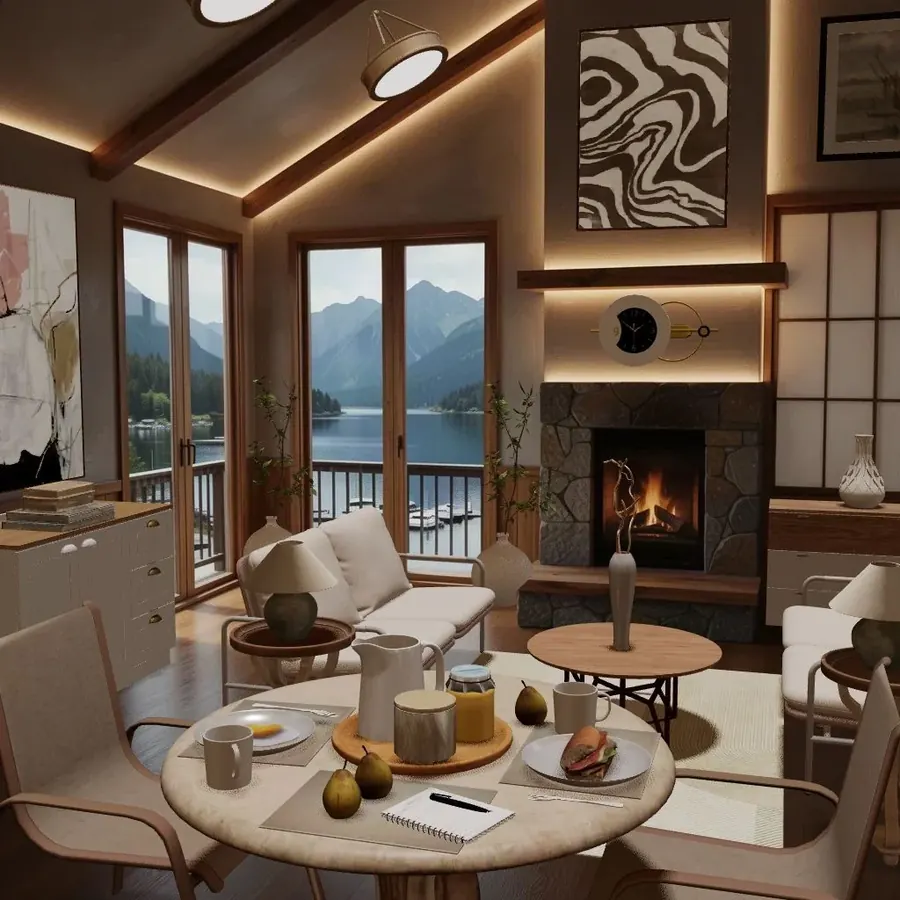
- An hour or two a week: a dining or breakfast table by a window is enough. The cover image shows the idea: a round table by the glass doors with a notebook, cups and a lake view. Clear the breakfast and it’s a pleasant place to write.
- Some days each week: a small desk or a fold-down wall desk that you can close.
- Every day, all day: a proper desk, a proper chair and a monitor. Your back will notice the difference within a week.
Find the corner
Good spots for a home office corner:
- Beside a window, with the desk at a right angle to the glass.
- An alcove beside a chimney breast or a built-in wardrobe.
- The end of a living room, behind the sofa or in a corner the seating doesn’t use. Our small living room ideas cover sharing a room with a desk.
- A landing or wide hallway, if it isn’t a main walkway.
- A bedroom, ideally where you can’t see the desk from the bed.
- A cupboard, with the doors removed or folding back (the “cloffice”).
Size the desk
| Desk type | Width | Depth | Fits |
|---|---|---|---|
| Wall-mounted or fold-down | 80–100 cm (31–39 in) | 40–50 cm (16–20 in) | A laptop and a notebook |
| Compact desk | 100–120 cm (39–47 in) | 50–60 cm (20–24 in) | A laptop, a lamp and some papers |
| Desk with a monitor | 120–140 cm (47–55 in) | 60–70 cm (24–28 in) | A monitor at arm’s length, keyboard and papers |
| Corner (L-shaped) desk | 120 × 120 cm (47 × 47 in) or more | 50–60 cm (20–24 in) | Two screens or a work and a craft side |
Most desks are 72–76 cm (28–30 in) high. Leave at least 60 cm (24 in) of clear width under the desk for your knees, and don’t let a drawer unit steal it.
Leave room for the chair
The chair needs more space than the desk.
- Behind the desk: about 75–90 cm (30–36 in) of clear floor to pull the chair out and stand up. Less than about 60 cm (24 in) feels cramped.
- Choose an adjustable chair if you work there daily: height, back support, and arms that slide under the desk.
- A rug or chair mat protects wooden floors from chair wheels and quietens the room.
- For occasional work, a comfortable dining chair is fine, but check that your elbows are at about desk height.
Get the light from the side
Light is where most desk corners go wrong.
- Put the window to one side. Daylight then falls across the desk without glare on the screen.
- Don’t face a bright window with your screen in front of it; your eyes keep adjusting between the two.
- Don’t sit with your back to the window either: the glass reflects in the screen, and on video calls your face is in shadow.
- Add a desk lamp on the side opposite your writing hand, so your hand doesn’t cast a shadow on the page.
- Use a warm-to-neutral white bulb (about 3000–4000K) for focused work if you like, and switch to warm lamps in the rest of the room in the evening.
- On video calls, face the window, or put a soft lamp behind the screen to light your face.
For how desk light fits with the rest of a room’s lighting, see our layered lighting guide.
Tidy the cables
Nothing makes a small office look messier than a tangle under the desk.
- Mount a power strip under the desk with screws or strong adhesive, so plugs stay off the floor.
- Run cables in a tray or basket fixed under the desktop.
- Bundle the rest with reusable cable ties or a fabric sleeve, and run it down a desk leg.
- Label the plugs at the power strip; it saves time later.
- Use wireless where you can: keyboard, mouse, a charging pad.
Store things upward
- Shelves above the desk for books and boxes; see how to style shelves so they don’t look like a stockroom.
- A pegboard or rail for headphones, notes and small tools.
- A drawer unit on wheels that rolls under the desk and out of the way.
- Matching boxes or baskets for paperwork, so open shelves stay calm.
Make it something you can close
If the desk is in a living room or bedroom, being able to hide it at the end of the day is the best small-office idea of all.
- A cupboard office: a desk built into a wardrobe or cupboard; close the doors at 6 p.m.
- A secretary desk or bureau with a fold-down flap.
- A fold-down wall desk that closes flat to 10–15 cm (4–6 in) deep.
- A curtain on a ceiling track across an alcove.
- A folding screen, which can stand in front of the desk in the evening.

The room above isn’t an office, but it shows what a folding screen can do: it splits one room into two areas without building a wall. In a living room, the same screen can stand in front of a desk corner at night.
Renting? Keep it reversible
Freestanding desks, a bookcase on its side as a desk base, adhesive cable clips, a clamp-on lamp and a tension rod with a curtain all come out without damage. Our rental decorating ideas cover more ideas that don’t need drilling.
Make it pleasant to sit at
A small office is easier to use if you like being there: a plant within sight, a picture or a view, a mug that’s yours, and a chair you don’t mind sitting in. Keep the desk surface mostly clear, and give everything else a home. For making a small room feel bigger around a desk, see our small space ideas.
Common mistakes
- No room behind the chair.
- The screen in front of a bright window, or the window right behind you.
- Only a ceiling light over the desk.
- Cables on the floor.
- A desk you can see from the bed, with no way to hide it.
- A pretty chair you can’t sit on all day.
Try it in Cozee
You can test where a desk fits before moving furniture at home. In Cozee, a free design game for iPhone and Android, you furnish empty 3D rooms with real furniture, from tables and shelves to lamps and plants. Try putting a desk or small table side-on to a window in a living room Space, then hiding it behind a screen or a bookcase, and see how the room changes. There are no timers, so you can move things around as long as you like before you submit.
Questions people ask
How much space do you need for a home office corner?
A workable corner needs a desk of at least 100 × 50 cm (39 × 20 in) for a laptop, or about 120 × 60 cm (47 × 24 in) with a monitor, plus about 75–90 cm (30–36 in) of clear floor behind it to pull out the chair. That’s roughly 1.2 × 1.5 m (4 × 5 ft) in total.
Where should a desk go in relation to a window?
Ideally side-on to the window, so daylight falls across the desk. A window behind the screen makes you squint, and a window behind you causes glare on the screen and leaves your face dark on video calls.
What height should a desk be?
Most fixed desks are 72–76 cm (28–30 in) high, which suits many adults with an adjustable chair. The test is simple: with your feet flat and shoulders relaxed, your forearms should rest roughly level on the desk. If they don’t, adjust the chair first, then add a footrest if your feet no longer reach the floor.
How do I separate work from home in a small apartment?
Make the work corner something you can close or cover: a desk inside a cupboard, a fold-down wall desk, a curtain or a folding screen. Put the laptop away at the end of the day and switch off the desk lamp, so the room goes back to being home.
Try it in an empty room first
Cozee is a free interior design game for iPhone and Android. Pick an empty 3D room, fill it with real furniture, and see what the community thinks.
4.7 on the App Store · Free, with optional in‑app purchases