

On this page 13 sections
A small room feels bigger when your eye can travel through it without stopping: light, continuous colors, visible floor, light from more than one source, a few well-scaled pieces instead of many small ones, and storage that keeps surfaces clear. Hang curtains high and wide, use a rug that’s big enough, and keep clear walkways of about 75–90 cm (30–36 in). Here is how to apply each idea, what to avoid, and a quick checklist for any small living room, bedroom or studio.
Start with what makes a room feel small
Before buying anything, it helps to know what actually shrinks a space visually:
- Clutter, especially on the floor and on flat surfaces.
- Hard visual breaks: dark furniture against light walls, a high-contrast skirting board, many different colors.
- Blocked light: heavy curtains hung inside the frame, furniture in front of windows.
- Bulky furniture with no legs, which hides the floor.
- Too many small things: tiny rugs, small art, lots of little side tables.
Most small-room advice is just removing one of these. If you’re unsure what your room’s real constraints are, our guide to reading a room before you decorate walks through measuring, light and traffic flow.
Color: keep it continuous
Light and soft is the safe bet
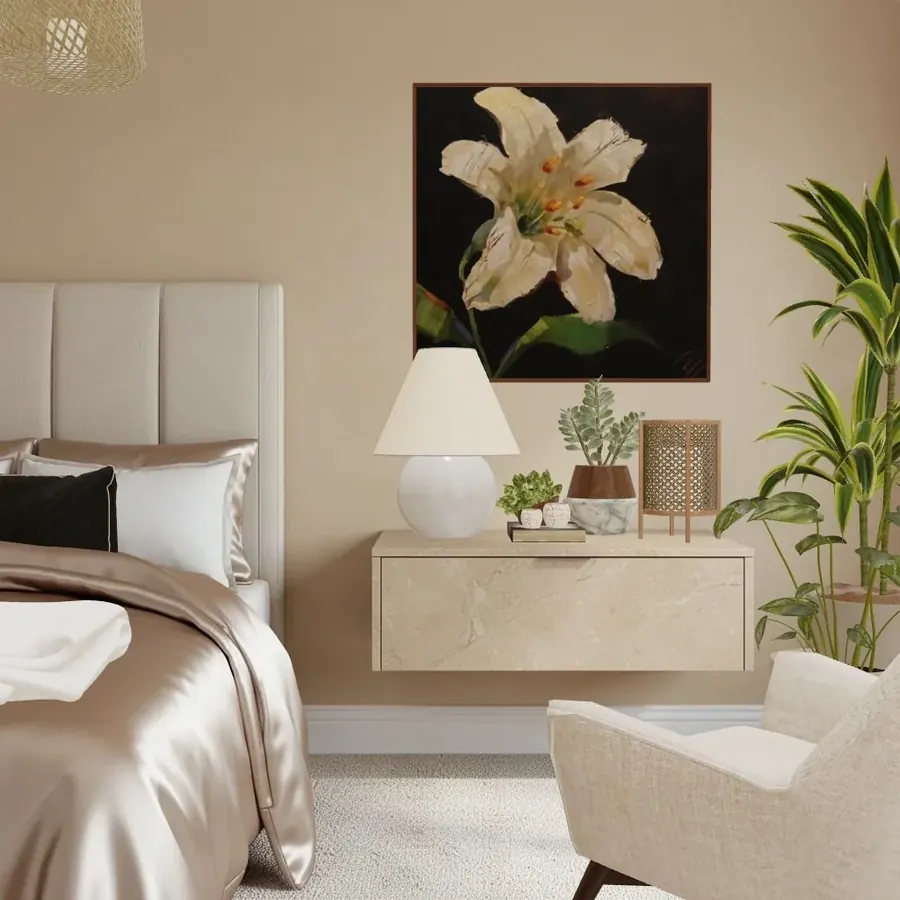
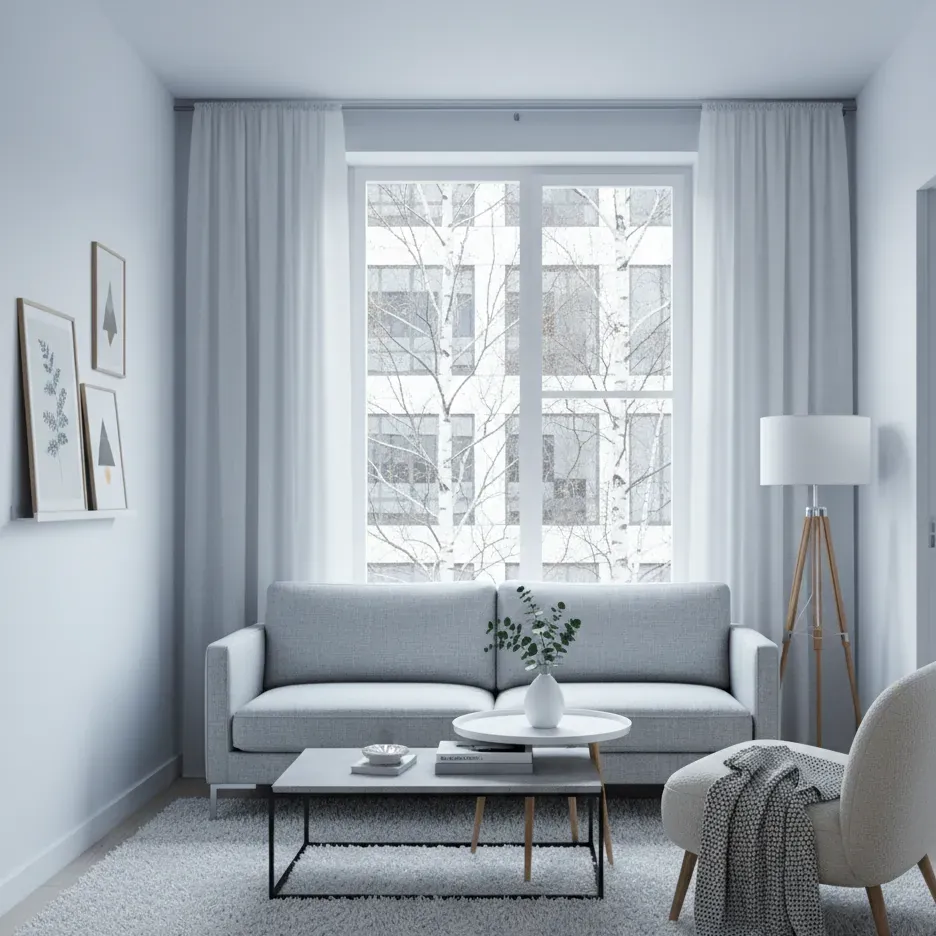
Pale walls reflect more daylight, so the room feels brighter and airier. Warm whites, soft greige, pale sage or a light beige like the cover image all work. The trick is to keep walls, trim and doors close in tone so the edges of the room blur.
Or go dark everywhere
A less obvious option is color drenching: painting walls, trim and sometimes the ceiling in the same deep shade. When corners and edges disappear, a small room can feel cocooning rather than cramped. It works best in rooms used mostly in the evening, like a snug or a bedroom. It doesn’t work half-done, with a dark wall next to bright white trim.
Limit the palette
Two or three main colors, repeated, look calmer than six. Our color theory guide explains how to build a palette with the 60-30-10 rule.
Light: more sources, less glare
A single ceiling light in a small room creates harsh shadows in the corners, which makes the walls feel closer. Instead:
- Add light at several heights. A floor lamp, a table lamp and maybe wall lights. Lighting the corners pushes the walls back visually.
- Choose wall-mounted or plug-in sconces next to a bed or sofa to save surface space.
- Use warm bulbs (around 2700–3000K) for living areas and bedrooms.
- Don’t block windows. Keep tall furniture away from them.
The layered lighting guide covers ambient, task and accent light in detail.
Windows and curtains: high and wide
This is one of the simplest tricks in decorating, and it works in every size of room.
- Hang the rod high, at least 10–15 cm (4–6 in) above the window frame, or close to the ceiling. Tall curtains make the ceiling feel higher.
- Extend the rod wide, about 15–30 cm (6–12 in) past each side of the frame, so curtains stack on the wall instead of over the glass. The window looks bigger and lets in more light.
- Let curtains just touch or kiss the floor. Curtains that stop short look skimpy.
- Choose light fabrics like linen or sheers in a color close to the wall.
Furniture: fewer, better-scaled pieces
Pick pieces with legs
Sofas, chairs, beds, consoles and dressers on raised legs show more floor, and more visible floor reads as more space. The beige bedroom in the cover image uses a floating nightstand fixed to the wall for the same reason: the floor runs under it uninterrupted.
Go for fewer, larger pieces
It sounds backwards, but one properly sized sofa looks calmer than a small sofa plus two armchairs and three side tables. Look for “apartment-size” sofas with slim arms: you keep the seat width while losing bulk.
Try see-through and light-looking pieces
Glass or acrylic tables, open metal frames, cane and caned backs let light through, so they occupy less visual space.
Make furniture work twice
- Ottomans and benches with storage inside.
- A drop-leaf or extendable table.
- A bed with drawers or lift-up storage.
- A sofa bed or daybed for guests.
- Nesting side tables that tuck away.
- A console behind a sofa that doubles as a desk.
Mind the scale
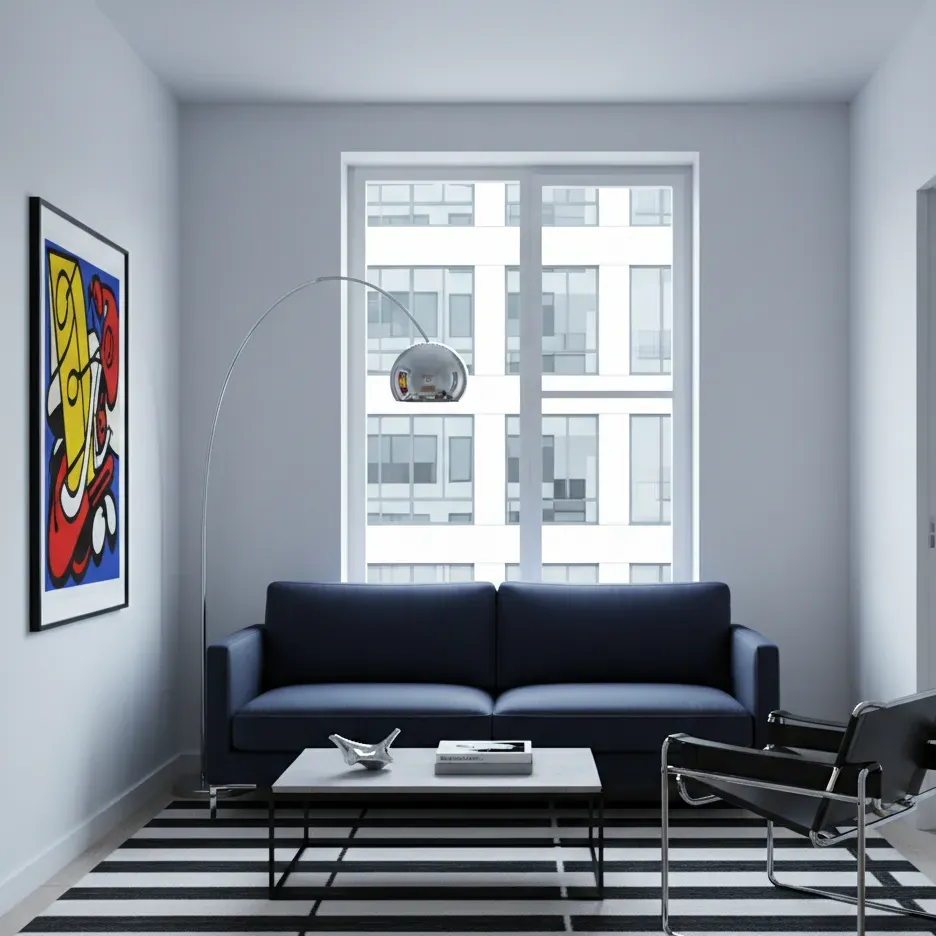
Scale is about how pieces relate to the room and each other, and getting it right matters more in a small room than anywhere. Our scale and proportion guide goes deeper.
Layout and walkways
Leave room to move. These are typical ranges designers work with; adjust for your household.
| Space | Typical clearance | Imperial |
|---|---|---|
| Main walkway through a room | 75–90 cm | 30–36 in |
| Narrow secondary path (beside a bed) | about 60 cm minimum | about 24 in |
| Sofa to coffee table | 40–45 cm | 16–18 in |
| Behind a dining chair to pull it out | about 90 cm | about 36 in |
| Front of a wardrobe or dresser to open drawers | about 75–90 cm | about 30–36 in |
Layout tips for small rooms:
- Float furniture slightly off the walls if you can. A few centimeters of space behind a sofa can make the room look less boxed in, though in very tight rooms against-the-wall is often the only practical option.
- Keep the path from the door clear. The first view into a room sets how big it feels.
- Zone a studio with rugs, a bookcase open on both sides, or a curtain, rather than solid dividers.
- Use corners: a corner desk, a round table, a reading chair with a floor lamp.
Rugs: go bigger
A rug that’s too small is one of the fastest ways to make a room feel smaller. In a living room, choose one large enough that at least the front legs of the sofa and chairs sit on it. In a bedroom, the rug should extend past the sides of the bed so your feet land on it when you get up. One large rug almost always looks better than several small ones.
Mirrors and reflective surfaces
- Place a large mirror next to or opposite a window to bounce daylight and the view.
- Lean a floor mirror against a wall for a relaxed look and an instant sense of depth.
- Add a little shine. Mirrored or glossy furniture, a metallic accent or satin-finish paint adds light without clutter.
- Check what it reflects. A mirror showing a cluttered shelf doubles the clutter.
Storage: up, under and hidden
- Go vertical. Tall, narrow bookcases and shelves to the ceiling draw the eye upward. See how to style shelves so they don’t look cluttered.
- Use the space under things: under the bed, under the stairs, under a window seat.
- Prefer closed storage for everyday clutter; keep open shelves for things you want on show.
- Hang it: hooks, rails and wall-mounted desks and nightstands.
- Edit regularly. Small rooms reward having less.
Art and decor
Counterintuitively, small rooms often look better with fewer, larger pieces of art than with lots of small ones. The single big lily painting in the cover image fills the wall above the nightstand without adding clutter. Hang art at eye level, about 145–152 cm (57–60 in) to the center, as explained in our guide to hanging art.
Common mistakes
- Pushing everything to the walls, leaving an empty middle with nothing to anchor it.
- Tiny rugs and tiny art.
- Too many colors and patterns chopping the room up.
- Curtains hung at the frame instead of high and wide.
- A single overhead light.
- Blocking the door or window with a tall piece.
Small-room checklist
- Walls, trim and doors in close tones
- Curtains hung high and wide
- At least three light sources at different heights
- Furniture on legs, or floating
- One rug, big enough for front legs
- A large mirror near the window
- Main walkway of 75–90 cm (30–36 in)
- Closed storage for everyday clutter
- Fewer, bigger pieces of art
Try it in Cozee
Small rooms are where a layout mistake shows most, so it pays to test ideas first. In Cozee, a free design game for iPhone and Android, every room starts empty and you place real 3D furniture by dragging, moving and rotating it. Try furnishing a room with as few pieces as possible and still making it feel complete, then see how other players designed the same Space. For more on getting the basics right, read the 7 principles of interior design.
Questions people ask
What color makes a small room look bigger?
Light, soft colors that reflect daylight are the classic choice, especially when walls, trim and sometimes the ceiling are close in tone so the edges blur. Dark colors can also work if you commit and paint everything the same deep shade, which makes corners recede. What tends to shrink a room is lots of contrasting colors breaking it into pieces.
Do mirrors really make a room look bigger?
They make it feel bigger by reflecting light and extending the view. A large mirror on a wall next to or opposite a window works best, because it bounces daylight and the outside view back into the room. A mirror that reflects clutter or a blank wall does much less.
Should you use small furniture in a small room?
Not necessarily. A room full of small pieces looks busy. It’s usually better to have fewer, well-proportioned pieces, such as one compact but full-size sofa rather than a loveseat plus two chairs. Choose pieces with slim arms and raised legs so they take up less visual space.
What size rug should go in a small living room?
Usually bigger than you think. A rug large enough for at least the front legs of the sofa and chairs to sit on it makes the seating area feel unified and the room larger. A small rug floating in the middle of the floor makes the room look smaller.
How much walkway space do you need in a small room?
Main walkways are typically 75–90 cm (30–36 in) wide. In tight spots, around 60 cm (24 in) is a common minimum for a secondary path, for example beside a bed. Around a coffee table, 40–45 cm (16–18 in) from the sofa is a comfortable reach.
Try it in an empty room first
Cozee is a free interior design game for iPhone and Android. Pick an empty 3D room, fill it with real furniture, and see what the community thinks.
4.7 on the App Store · Free, with optional in‑app purchases