

This glossary explains the interior design terms you’ll come across in magazines, shops, paint charts and design shows, in plain English. It covers color and light, furniture and upholstery, architectural details, layout and the names of the main styles. Where we have a full guide on a topic, the term links to it.
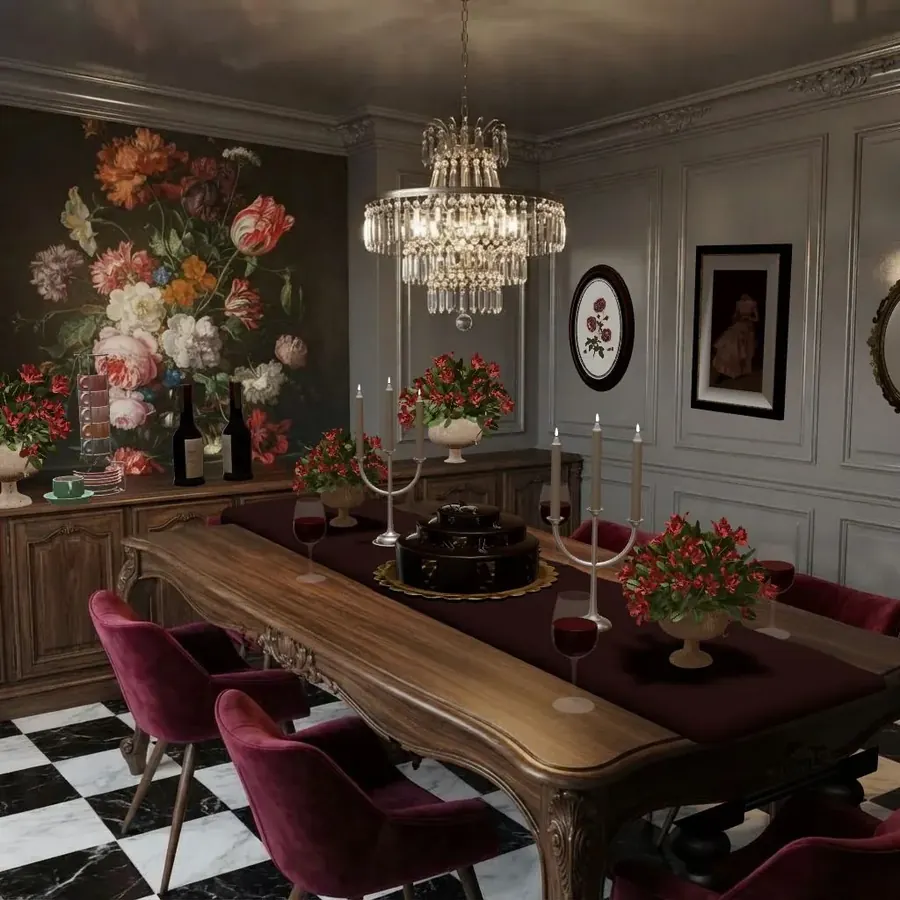
The cover room is a handy illustration of several entries at once: a mural across one wall, a crystal chandelier, paneling with molding, velvet upholstery and a checkered floor in strong contrast.
A–C
Accent chair. A chair chosen to stand out from the main seating, usually through color, pattern or shape, rather than to match the sofa.
Accent lighting. Focused light that highlights something specific, such as art, a shelf or a plant. One of the three classic layers of lighting, with ambient and task light.
Accent wall. One wall painted or papered differently from the others to draw attention, often the wall behind a bed or sofa.
Alcove. A recess set back into a wall, often beside a chimney breast or around a window. Alcoves are natural spots for built-in shelves, desks or a reading nook.
Ambient lighting. The general, overall light in a room, from ceiling lights, pendants or daylight. It lets you see and move around safely.
Analogous colors. Colors that sit next to each other on the color wheel, such as blue, blue-green and green. They create calm, harmonious schemes. See color theory for rooms.
Art Deco. A decorative style that peaked in the 1920s and 1930s, known for geometric patterns, symmetry, rich materials, lacquer, brass and glamorous curves. It’s a big influence on today’s luxury glam interiors.
Asymmetrical balance. Balance created with different objects of similar visual weight on each side, for example a tall plant on one side of a sofa and two stacked side tables on the other. It feels more relaxed than strict symmetry.
Baseboard. The board that runs along the bottom of a wall where it meets the floor. In British English it’s a skirting board.
Biophilic design. Design that connects people with nature through daylight, views, plants, natural materials and organic shapes.
Bouclé. A fabric woven from looped yarn, giving a nubbly, textured surface. Popular on rounded chairs and sofas.
Built-in. Furniture fixed into the room’s structure, such as fitted shelves, window seats and wardrobes.
Chair rail. A horizontal molding fixed around a wall at roughly chair-back height, which also helps protect the wall from chair backs. It often marks the top of the dado.
Chandelier. A decorative hanging light with several arms or lights, traditionally dressed with crystal or glass drops, used as a statement piece over a dining table or in a hall.
Channel tufting. Upholstery stitched into vertical or horizontal padded channels, like the teal sofas in our decorating mistakes cover image.
Chesterfield. A sofa with deep button tufting, rolled arms the same height as the back, and usually leather upholstery.
Color temperature. How warm or cool a light source looks, measured in kelvin (K). Around 2700–3000K is warm and cozy; around 4000K is neutral; higher values look cool and bluish.
Complementary colors. Colors opposite each other on the color wheel, such as blue and orange or green and red. Together they create strong contrast.
Console table. A long, narrow table, often placed against a wall or behind a floating sofa.
Contrast. Difference between elements, in color, light and dark, texture or shape. Contrast creates interest and helps define a focal point.
Crown molding. Decorative molding where the walls meet the ceiling. In British English it’s often called coving or cornice.
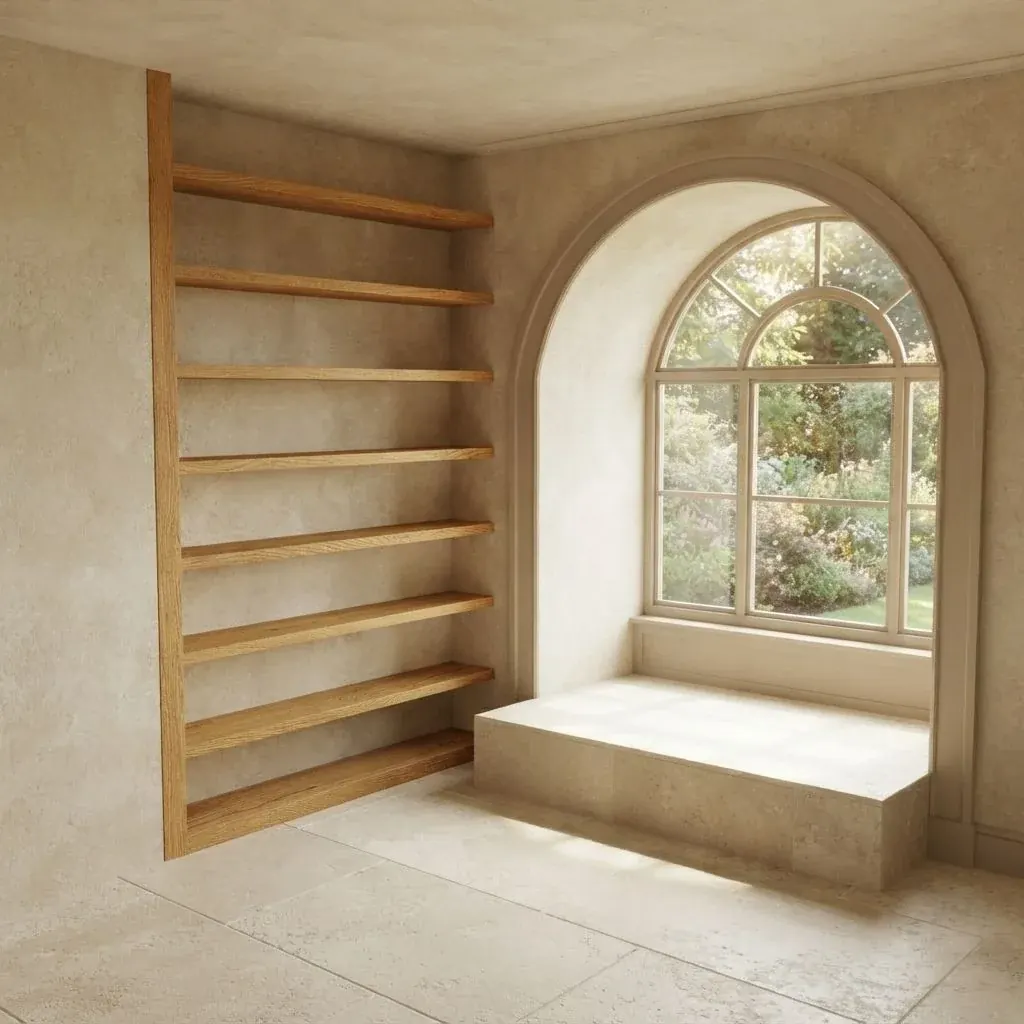
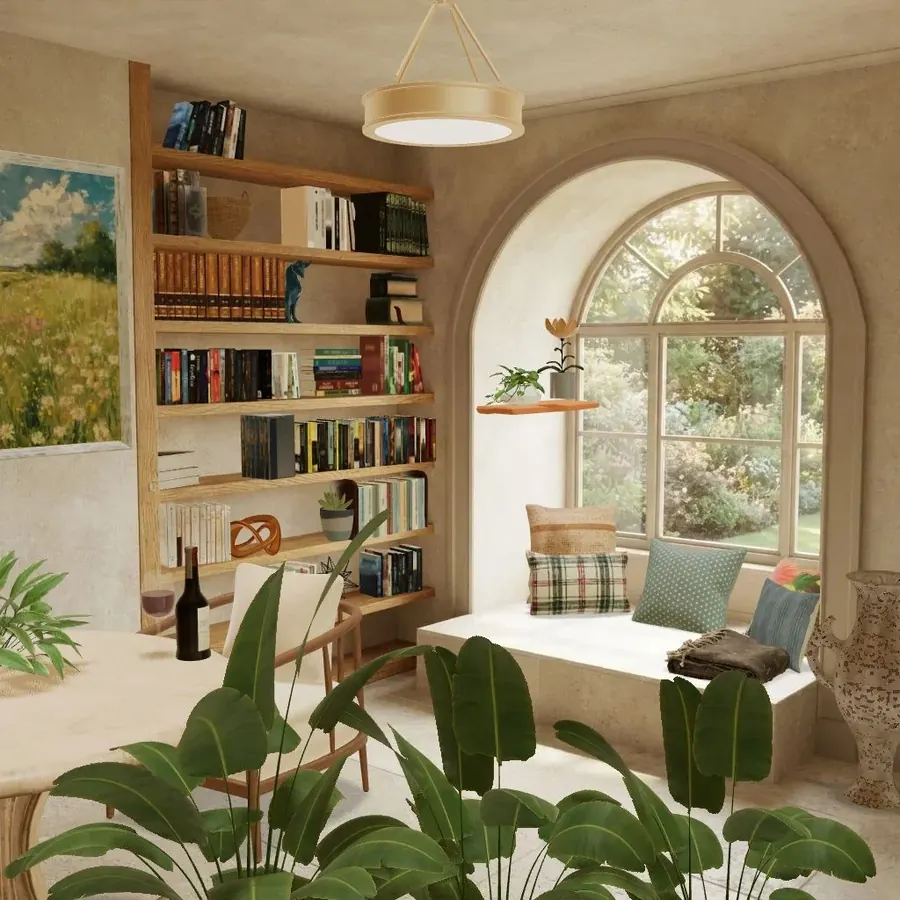
That empty nook shows several architectural terms together: built-in shelving in an alcove, and a deep arched window with a stone seat. A furnished version of this space leads our guide to furnishing an empty room.
D–F
Dado. The lower part of a wall, below the chair rail. A “dado rail” is the British term for a chair rail.
Distressed finish. A surface deliberately worn or aged to look old, common in rustic farmhouse furniture.
Eclectic. A style that mixes periods, cultures and styles in one room, held together by a shared color thread or repeated shapes. See our eclectic style guide.
Eggshell. A paint finish with a slight sheen, between matte and satin. It’s easier to wipe than matte and still hides some flaws.
Floating furniture. Furniture placed away from the walls, for example a sofa in the middle of a room with a console table behind it.
Focal point. The first place the eye goes in a room: a fireplace, window, headboard or large artwork. Layout and the strongest color usually revolve around it.
Fullness. How much fabric a curtain has compared with the width it covers. Curtain panels are often around one and a half to two times the window width so they hang in soft folds.
G–L
Gallery wall. A group of framed pictures, mirrors or objects arranged together on one wall. See how to hang art and plan a gallery wall.
Greige. A mix of grey and beige: a neutral that sits between warm and cool.
Hardware. The handles, knobs, pulls and hinges on cabinets, doors and furniture. Changing hardware is a quick, inexpensive update.
Hue. The pure name of a color (red, blue, yellow) before it’s lightened, darkened or muted.
Industrial. A style inspired by old factories and warehouses: exposed brick, metal, concrete, leather and visible pipes or bulbs. See our industrial style guide.
Japandi. A blend of Japanese and Scandinavian design: low furniture, warm neutrals, mixed woods and very little clutter. See our Japandi guide.
Kilim. A flat-woven rug or textile with no pile, traditionally made in regions including Turkey, the Caucasus, Iran and Central Asia, usually in bold geometric patterns.
Layering. Building a room up in levels, for example several rugs, several light sources, or cushions and throws in different textures, so it feels rich rather than flat.
LRV (light reflectance value). A number from 0 (black) to 100 (white) on paint charts showing how much light a color reflects.
Lumens. The measure of how much light a bulb gives out. More lumens means a brighter bulb, regardless of the watts it uses.
M–O
Matte. A flat paint or surface finish with no shine. It hides imperfections but can be harder to clean. Also spelled “matt.”
Mid-century modern. A style from roughly the mid-1940s to the late 1960s: tapered legs, clean lines, warm woods such as teak, and organic curves.
Minimalism. A style built on very few pieces, clear surfaces and lots of empty space. See our minimalist style guide.
Molding. Decorative strips of wood, plaster or other material used on walls, ceilings, doors and furniture. Spelled “moulding” in British English.
Monochromatic. A color scheme built from one hue in different tints, shades and tones.
Mood board. A collage of images, colors, fabrics and materials used to plan the look of a room before buying anything.
Mural. A large picture painted or printed directly onto a wall, or a wallpaper that does the same job.
Negative space. The empty space around and between objects. Leaving some makes a room feel calm and lets important pieces stand out.
Neutral. A color without strong hue, such as white, cream, beige, greige, taupe, grey and black. Neutrals often form the base of a palette.
Open plan. A layout where kitchen, dining and living areas share one space without walls between them.
Ottoman. An upholstered footstool or low seat without a back, sometimes with storage inside.
P–R
Palette. The set of colors chosen for a room.
Paneling. Wood or other boards fixed to a wall, either covering it fully or just the lower part, often in a decorative frame pattern.
Patina. The soft sheen or change of color that develops on wood, leather, brass and stone with age and use.
Pendant. A light fitting that hangs from the ceiling on a cord, chain or rod.
Proportion. How the sizes of parts relate to each other and to the whole, for example a coffee table about two-thirds the length of the sofa. See scale, proportion and flow.
Rattan. A climbing palm whose stems are woven into furniture, lamps and baskets. Cane is the thinner outer skin of rattan.
Rhythm. The repetition of a color, shape or pattern around a room that leads the eye from one place to another. One of the principles of interior design.
Rule of three. The styling habit of grouping objects in threes or other odd numbers, which tends to look more natural than even pairs.
S–T
Saturation. How intense or pure a color is. High saturation is vivid; low saturation is muted and greyed.
Scale. The size of an object compared with the room and the people in it. A huge sofa in a small room is “out of scale.”
Sconce. A light fixed to a wall.
Sectional. A sofa made of several joined sections, often forming an L or U shape.
Shiplap. Wooden boards fixed horizontally on a wall with a small gap or groove between them, common in farmhouse and coastal rooms.
Sight line. The view from one point in a home to another, for example from the front door through to a window. Designers place focal points along key sight lines.
Statement piece. A single item meant to grab attention, such as a bold chandelier, an oversized artwork or an unusual chair.
Symmetry. Balance created by mirroring the same things on either side of a center line, for example matching lamps on either side of a bed. It feels formal and calm.
Task lighting. Bright, focused light for an activity such as reading, cooking or working.
Texture. How a surface feels or looks like it would feel: rough, smooth, soft, glossy, woven. See how to mix materials and textures.
Tint, shade and tone. A tint is a hue mixed with white, a shade is a hue mixed with black, and a tone is a hue mixed with grey.
Tone-on-tone. A scheme that uses several closely related versions of one color, often with different textures, for a subtle, layered look.
Traffic flow. The routes people take through a room. Main walkways are usually kept about 75–90 cm (30–36 in) wide.
Trim. The woodwork that frames a room’s openings and edges: door and window casings, baseboards and moldings.
Tufting. Upholstery pulled tight in a pattern with buttons or stitches, creating dimples or channels.
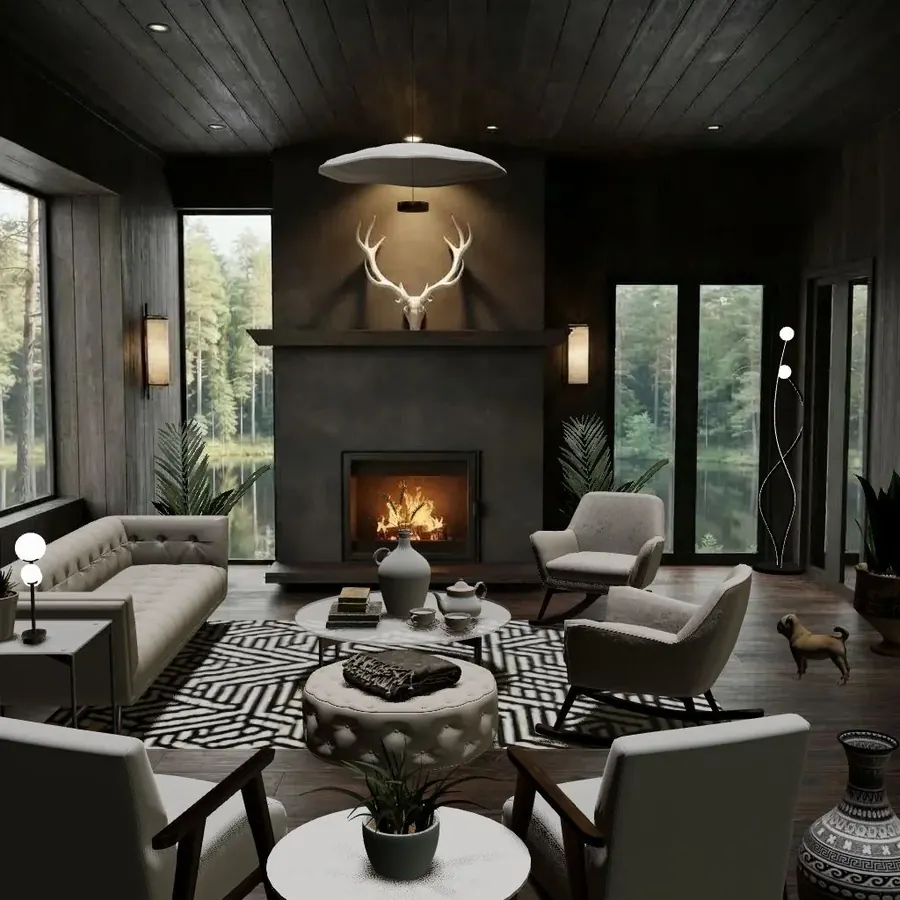
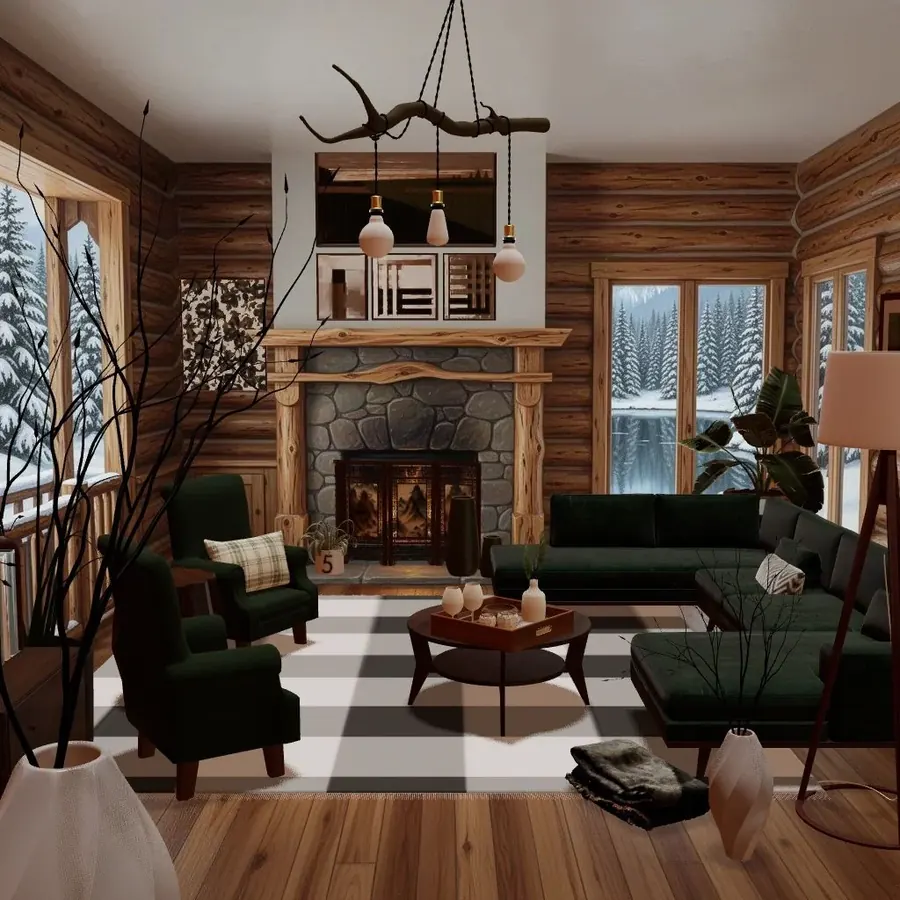
In the cabin above, the fireplace is the focal point, the two sconces either side of it are a classic use of symmetry, and the geometric rug adds contrast against the dark floor.
U–Z
Undertone. The subtle color beneath the main one. A white can have a yellow, pink, blue or green undertone, which shows next to other colors and in different light.
Upholstery. The padding, springs, webbing and fabric covering on sofas and chairs, and the craft of making it.
Velvet. A woven fabric with a short, dense pile that gives a soft feel and a sheen that changes with the light.
Vignette. A small, styled arrangement of objects, such as a lamp, a stack of books and a vase on a side table, that tells a little story.
Wabi-sabi. A Japanese idea of finding beauty in what is simple, imperfect and aging, such as handmade ceramics and weathered wood.
Wainscoting. Paneling on the lower part of a wall, traditionally wood.
Warm and cool colors. Warm colors (reds, oranges, yellows) feel cozy and tend to advance; cool colors (blues, greens, violets) feel calm and tend to recede.
Zoning. Dividing one space into areas for different uses, such as a reading corner, a dining area and a seating group, using rugs, lighting and furniture placement.
Try it in Cozee
The fastest way to make these terms stick is to use them. Cozee is a free interior design game for iPhone and Android where every room starts empty and you design it with real 3D furniture and decor. Try building one room around a single focal point, or a monochromatic palette, and then see how other players designed the same room. For the bigger picture, start with our guide to interior design styles.
Questions people ask
What is the difference between a tint, a shade and a tone?
They’re all variations of one hue. A tint is the hue mixed with white (lighter), a shade is the hue mixed with black (darker), and a tone is the hue mixed with grey (softer and more muted). Many calm interiors are built mostly from tints and tones.
What is the difference between wainscoting and a dado?
The dado is the lower part of a wall, below a horizontal rail at roughly chair-back height. Wainscoting is the paneling, often wood, that covers that lower section. In everyday use, the words often overlap.
What does LRV mean on a paint chart?
LRV stands for light reflectance value: a scale from 0 (absolute black) to 100 (pure white) showing how much light a color reflects. Higher numbers look lighter and bounce more light around a room; very low numbers absorb light and feel darker and cozier.
What is the difference between a sectional and a sofa?
A sofa is a single piece. A sectional is made of several sections that join together, often into an L or U shape, and some can be rearranged. Sectionals seat more people but need more floor space.
What is a focal point in interior design?
It’s the place your eye goes first when you walk into a room, such as a fireplace, a large window, a bed headboard or a big piece of art. Designers arrange furniture and use their strongest color or pattern around it so the room feels organized.
Try it in an empty room first
Cozee is a free interior design game for iPhone and Android. Pick an empty 3D room, fill it with real furniture, and see what the community thinks.
4.7 on the App Store · Free, with optional in‑app purchases